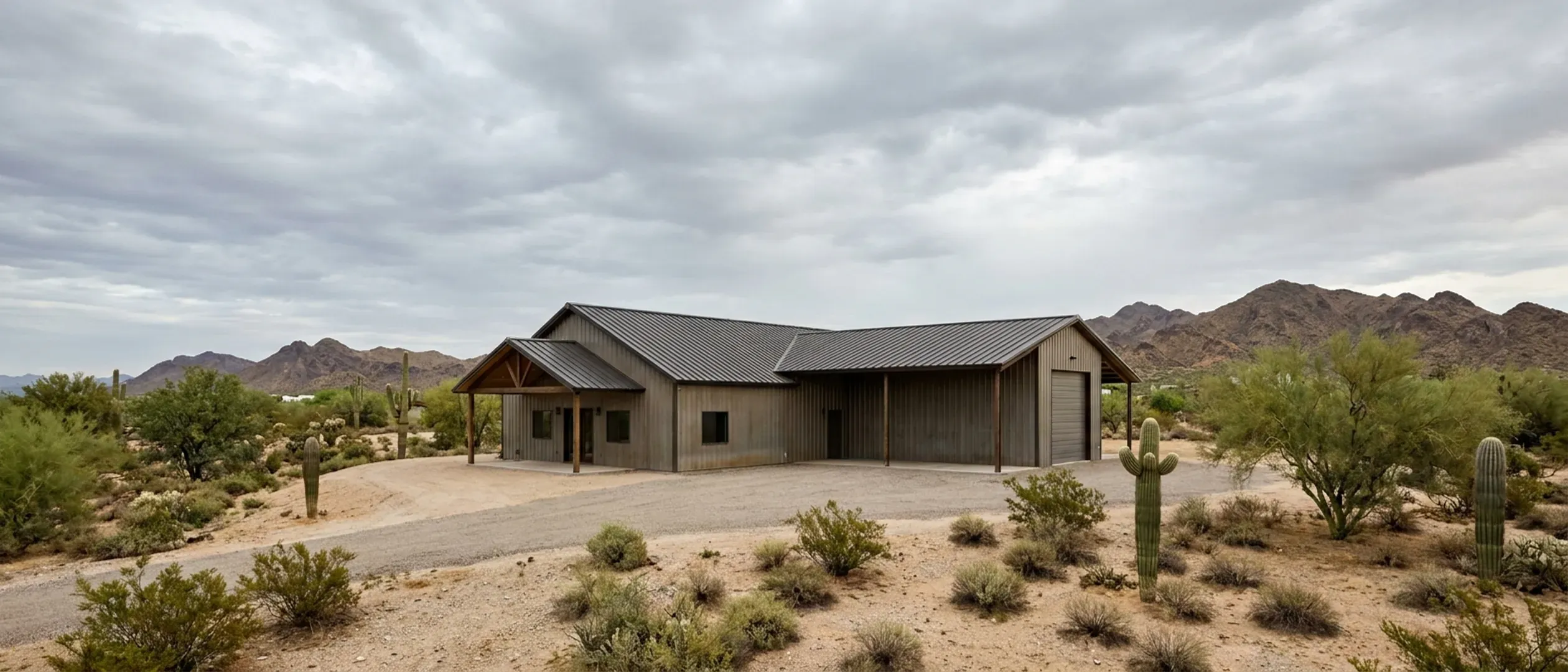
Barndominium Cost in Arizona: What It Costs to Build One in 2026
No agency publishes a barndominium cost for Arizona, and a single statewide price per square foot hides most of what decides a real budget. What does exist is specific and dated: the Census Bureau's 2025 cost per square foot for homes built on the owner's land in the West, NAHB's breakdown of where construction money goes, USDA's 2026 land values, and the fees Arizona counties and cities publish for a septic permit, a building permit and development impact fees. This guide sets out the cost to build a barndominium in Arizona from those figures, each with its source and date. None of the numbers below is our price.
Figures below are industry data from cited third-party sources, not a quote from Arizona Barndominium Builders. Every project is priced individually.
Bottom Line Up Front
- The closest published benchmark is the Census Bureau's 2025 contract price for homes built on the owner's land in the West region: $176.87 per square foot at the median and $213.85 on average, land excluded. On those Census rates a 2,000 square foot home is about $354,000 to $428,000 before land.
- A barndominium shell changes the framing and exterior lines of a budget, not the whole of it. NAHB's 2024 survey puts framing at 16.6% and exterior finishes at 13.4% of construction cost, while interior finishes (24.1%) and mechanical rough-ins (19.2%) cost the same whatever holds the roof up.
- In Arizona the fees depend on where the parcel sits. Maricopa County's conventional septic review is $757 and Pima County's is $270; Phoenix's published impact fees for one single-family home run from $5,458 to $37,866 by service area; APS pays the first $10,000 of a line extension to a new home and the owner pays the rest.
Published cost figures
Third-party and government figures, each with its source. None of them is a quote, and none of them is ours.
| Measure | Range | Source |
|---|---|---|
| Contractor-built homes on the owner's land, West region, 2025: median to average contract price (land excluded) | $177–$214 per sq ft | U.S. Census Bureau, Characteristics of New Housing 2025: West median $176.87, average $213.85 contract price per sq ft, contractor-built houses started — https://www.census.gov/construction/chars/xls/contractpricesqft_cust.xls |
| New homes sold by builders, West region, 2025: median to average sales price (lot excluded) | $212–$224 per sq ft | U.S. Census Bureau, Characteristics of New Housing 2025: West median $212.50, average $224.31 price per sq ft of floor area, new single-family houses sold — https://www.census.gov/construction/chars/xls/soldpricesqft_cust.xls |
| Average construction cost only (no lot, overhead or profit), national builder survey, 2024 | $162 per sq ft | NAHB, Cost of Constructing a Home 2024 (January 2025): average construction cost $428,215 on 2,647 sq ft, about $162 per sq ft — https://www.nahb.org/news-and-economics/housing-economics-plus/special-studies/special-studies-pages/cost-of-constructing-a-home-in-2024 |
| Arizona farm real estate, average value (land and buildings), 2026 | $4,300 per acre | USDA NASS, Land Values 2026 Summary (July 2026): Arizona $4,300 per acre, up 2.9% from 2025, excluding American Indian Reservation land — https://esmis.nal.usda.gov/sites/default/release-files/795999/land0726.pdf |
| County review fee, conventional septic system (general permit 4.02): Pima County to Maricopa County | $270–$757 per system | Pima County DEQ review fees: $270 tank and leach field (plus $130 per final inspection); Maricopa County Environmental Health Code ch. 1 (rev. 08/19/2026): $757 flat, conventional under 3,000 gal/day — https://content.civicplus.com/api/assets/az-pimacounty/0186185b-6356-4060-8ddc-1bafd9139a42 and https://www.maricopa.gov/DocumentCenter/View/5500/Chapter-1---General-Provisions-PDF |
| City of Phoenix development impact and water resource fees, one single-family home (meter up to 1 inch), by service area | $5,458–$37,866 per home | City of Phoenix, 2025 Development Impact Fee Update, fee schedules by land use, effective 6-23-2025 (sum of all single-family categories per service area: $5,458 Balance of City to $37,866 Paradise Ridge) — https://www.phoenix.gov/content/dam/phoenix/pddsite/documents/impact-fees/2025-if-update/fee-schedules-by-land-use.pdf |
Estimate a range for your square footage
Pick a size and a tier and this multiplies them against the same industry ranges printed in the table above, nothing new, nothing ours. It's a starting orientation, not a quote.
Estimated range
$0 – $0
This estimate comes from the third-party cost data cited in the table above, not from Arizona Barndominium Builders. It doesn't account for your land, your county, or your finish choices, all of which move the real number. Start the survey with your parcel for one that does.
Total cost by size
Rough totals at common sizes. These move with everything on this page, so treat them as a starting orientation, not an estimate for your project.
1,200 sq ft
$212,000–$257,000
Arithmetic: 1,200 sq ft × the Census 2025 West contract price per sq ft ($176.87 median, $213.85 average), land excluded — https://www.census.gov/construction/chars/xls/contractpricesqft_cust.xls
1,800 sq ft
$318,000–$385,000
Arithmetic: 1,800 sq ft × the Census 2025 West contract price per sq ft ($176.87 median, $213.85 average), land excluded — https://www.census.gov/construction/chars/xls/contractpricesqft_cust.xls
2,400 sq ft
$424,000–$513,000
Arithmetic: 2,400 sq ft × the Census 2025 West contract price per sq ft ($176.87 median, $213.85 average), land excluded — https://www.census.gov/construction/chars/xls/contractpricesqft_cust.xls
3,000 sq ft
$531,000–$642,000
Arithmetic: 3,000 sq ft × the Census 2025 West contract price per sq ft ($176.87 median, $213.85 average), land excluded — https://www.census.gov/construction/chars/xls/contractpricesqft_cust.xls
What actually moves the number
Finish level, not the shell
NAHB's 2024 survey puts interior finishes at 24.1% of construction cost and mechanical rough-ins at 19.2%, against 16.6% for framing. Cabinets, flooring, plumbing and HVAC cost about the same inside a steel or pole-barn shell as inside a stick-built one, so finish choices move a budget more than the frame does.
Water and septic
Off a city sewer, a septic system needs a county permit first. Pima County's review fee for a conventional tank and leach field is $270, Pinal County's first Type 4 general permit is $1,200 and Maricopa County's conventional review is $757. In the West, Census found 40% of 2025 contractor-built homes on septic and 26% on both septic and their own water supply.
Caliche and expansive ground
University of Arizona Cooperative Extension describes caliche, soil cemented by calcium carbonate, as a common problem in southern Arizona soils, ranging from loose lumps to a solid, rock-like layer several feet thick. It can slow footings, trenches and septic fields. Ask for a soils report and whether each excavation bid assumes rock.
Land, access and the power line
USDA puts Arizona farm real estate at $4,300 an acre in 2026, an average across ranch and farm land. The cheapest acre is often the farthest from a power line. Under APS Service Schedule 3 (effective March 8, 2024), the utility covers extension costs to a new single-family home up to $10,000 and the applicant pays the rest; other utilities and cooperatives file their own rules.
What the average cost to build a barndominium in Arizona really means
The Census Bureau's Survey of Construction separates homes built for an owner on the owner's own land from homes a builder sells. The first group is the barndominium buyer's situation.
Contractor-built means your land, your contract
Census contract prices for contractor-built houses cover homes built for owner occupancy on the owner's land, and the contract price excludes the lot. That matches how a barndominium on land you already own is usually priced.
The West region, not an Arizona number
Census publishes these prices by region, and Arizona sits in the West, which also includes far costlier coastal markets. In 2025 the Census West median was $176.87 per square foot and the average $213.85. Treat the median as the more useful anchor and the average as pulled upward by the high end.
What those homes looked like
The median West contractor-built home completed in 2025 had 2,354 square feet on a median lot of 43,846 square feet, about an acre. Census data show 61% on slabs, 20% on crawl spaces and 19% over basements; 33% had stucco walls and 37% fiber cement. Only 1% were steel-framed.
Why builder-sold homes cost more per foot
Census data show new homes sold by builders in the West averaged $224.31 per square foot in 2025, above the contract figure. That sales price carries the builder's marketing, sales and profit, which a contract on your own land does not include in the same way.
Barndominium construction costs, stage by stage
NAHB's 2024 Cost of Constructing a Home survey breaks the average $428,215 construction cost into eight stages. A barndominium kit or shell replaces only some of them.
Framing and exterior: the part a kit replaces
NAHB puts framing including the roof at 16.6% of construction cost ($70,982) and exterior finishes at 13.4% ($57,510). A steel or pole-barn kit with metal roofing and wall panels stands in for these lines. Compare any kit price against those two stages, not against the whole house.
Interior finishes: the biggest single stage
Interior finishes are 24.1% of construction cost in NAHB's survey: insulation, drywall, trim, cabinets, counters, flooring, fixtures and paint. A barndominium has the same kitchen and bathrooms as any house, so this stage does not shrink because the walls are steel.
Heat changes the mechanical and insulation lines
NAHB's average HVAC line is $26,938 and insulation $6,992. In the low desert a tall, open barndominium has a large volume to cool; Flagstaff's criteria name ACCA Manual J data for HVAC sizing where it is used. Settle ceiling height, insulation and duct routing before the shell is ordered.
Foundation, site work and fees
NAHB puts foundations at 10.5% and site work at 7.6% of construction cost, with building permit fees averaging $7,640, impact fees $6,367 and water and sewer fees $6,260 nationally. In Arizona those fee lines vary more by address than by house, as the county and city schedules above show.
Arizona land, water and site costs
Land prices, water and ground conditions differ sharply between the Valley, southern Arizona and the high country. These are the lines that make two same-size barndominiums cost different amounts.
What USDA's land survey says
USDA NASS puts Arizona's 2026 average farm real estate value at $4,300 per acre, up 2.9% from 2025, against a national average of $4,500. The figure excludes reservation land and averages ranchland with irrigated farmland; a buildable parcel near a city or on a paved road sells for far more.
Septic fees by county
The county review fee is only the permit. Pima County DEQ charges $270 to review a conventional tank and leach field and $130 per final inspection. Pinal County's schedule effective December 2, 2023 charges $1,200 for the first Type 4 general permit and $500 for each additional one. The tank, field and installation are priced separately.
Wells and domestic water
Where there is no water provider, a private well becomes a budget line. A.R.S. 45-454 exempts non-irrigation wells with a pump of 35 gallons a minute or less, and a notice of intention to drill is filed with the Department of Water Resources first. Pinal County's schedule lists a $200 fee for its review of a domestic well application. Drilling cost depends on depth to water, so get a written quote for the parcel. Some rural homes rely on hauled water instead; check the county's rules and the nearest fill station.
Kit delivery to a remote parcel
A kit or shell quote may be priced at the plant or delivered to your site. On a rural parcel far from paved roads, confirm freight, unloading equipment and access for a truck before comparing two kit prices.
Building a realistic Arizona barndominium budget
Put the published figures in order and a first budget takes shape before anyone quotes you.
1. Start with the land and what it lacks
Price the parcel, then list what it does not have: water, sewer, power, a legal all-weather access road. Each missing item becomes a line of its own: a well, a septic system, a line extension, a driveway.
2. Price the house from a published rate
Multiply the planned heated square footage by the Census West contract rate: $176.87 median, $213.85 average. On the Census rates a 1,800 square foot home works out to about $318,000 to $385,000 before land. Use the median for a plain finish and the average for a well-finished one.
3. Price shop space and porches separately
Many barndominiums put a shop or garage under the same roof. Unfinished shop area does not carry kitchens, bathrooms or interior finishes, so price it as its own line rather than at the living-area rate.
4. Add fees, tax and a contingency
Add the building permit and plan review from the jurisdiction that issues it, the county septic fee, any city impact fees, and transaction privilege tax if it is not in the contract price. Then hold a contingency for what the soils report and the well driller find.
Reading this because you are weighing a build? The next step is a plan drawn for your program.
What's different about Arizona
Impact fees can outweigh the permit
A.R.S. 9-463.05 lets Arizona cities and towns assess development fees for public services a new home needs, based on an adopted infrastructure plan. Phoenix's schedule effective June 23, 2025 totals $5,458 per single-family home in the Balance of City area and $37,866 in Paradise Ridge. Unincorporated Pinal County's schedule (effective December 29, 2020) runs from $705 to $3,370 per home by service area.
Building permit fees follow a valuation table
Unincorporated Maricopa County sets its building permit fee from a valuation table: $993.75 for the first $100,000 plus $5.60 per $1,000 up to $500,000, with plan review at 65% of the permit fee. On that schedule a $400,000 valuation carries about $2,674 in permit fee and $1,738 in plan review. The county sets valuation from published building valuation data, not from your contract price.
Transaction privilege tax is built into contracting
Arizona taxes construction contracting under the prime contracting classification of transaction privilege tax. Under A.R.S. 42-5075 the tax base is 65% of the contract's gross proceeds, with the price of land deducted first, and the rate combines state, county and city rates for the job site. Ask every bidder whether a price includes it.
Snow load in the high country, heat in the desert
Design loads are set by the jurisdiction. Flagstaff's building design criteria set a 60 psf ground snow load, a 30-inch frost line and a 4°F winter design temperature. Maricopa County's local additions list ground snow load as not applicable and frost line depth as 0, with a 71.2°F mean annual temperature. A roof and frame engineered for Flagstaff snow costs more than one for the Valley.
What is the average cost to build a barndominium in Arizona?
How much does a barndominium cost per square foot in Arizona?
Is a barndominium cheaper than a house in Arizona?
What does a septic permit cost in Arizona?
What are impact fees on a new home in Arizona?
How much does it cost to bring power to rural land in Arizona?
Is land cheap in Arizona?
Does a barndominium cost more in Flagstaff than in Phoenix?
Do I pay tax on a new home build in Arizona?
Questions answered? Tell us what you want to build and we will put real numbers against it.
Sources
- U.S. Census Bureau — Median and Average Contract Price per Square Foot of New Contractor-Built Single-Family Houses Started (Characteristics of New Housing 2025) — West 2025: median $176.87, average $213.85 per sq ft; contract price excludes the lot
- U.S. Census Bureau — Price per Square Foot of Floor Area, New Single-Family Houses Sold — West 2025: median $212.50, average $224.31
- U.S. Census Bureau — Square Feet of Floor Area in New Single-Family Houses Completed — West contractor-built 2025: median 2,354 sq ft
- U.S. Census Bureau — Lot Size of New Single-Family Houses Completed — West contractor-built 2025: median lot 43,846 sq ft
- U.S. Census Bureau — Type of Foundation in New Single-Family Houses Completed — West contractor-built 2025: 61% slab, 20% crawl space, 19% basement
- U.S. Census Bureau — Primary Type of Exterior Wall Material and Type of Framing, New Single-Family Houses Completed — West contractor-built 2025: 99% wood-framed, 1% steel; walls 33% stucco, 37% fiber cement (exwallmat_cust.xls)
- U.S. Census Bureau — Type of Sewage System by Water Supply Source in New Single-Family Houses Completed — West contractor-built 2025: 40% septic; 26% septic with an individual water supply
- NAHB — Cost of Constructing a Home 2024 (Special Study, January 2025) — Table 1: construction cost $428,215 on 2,647 sq ft; stage shares and fee averages
- USDA NASS — Land Values 2026 Summary (July 2026, PDF) — Arizona farm real estate $4,300 per acre, up 2.9%; United States $4,500
- Maricopa County Environmental Services — Environmental Health Code, Chapter 1 (rev. 08/19/2026, PDF) — Onsite wastewater plan review: conventional under 3,000 gal/day $757; alternative $1,344
- Pima County DEQ — Review Fees for Conventional and Alternative Onsite Wastewater Treatment Facilities (PDF) — Conventional 4.02 tank and leach field $270; final inspection $130 per visit
- Pinal County Development Services — New Aquifer Protection Fee Schedule, effective December 2, 2023 (PDF) — First Type 4 general permit $1,200; each additional $500; ADWR domestic well approval $200
- Pinal County — Development Fee Schedule, effective December 29, 2020 (PDF) — Single-family totals by service area, $705 to $3,370
- City of Phoenix — 2025 Development Impact Fee Update, fee schedules by land use, effective 6-23-2025 (PDF) — Single-family, meter up to 1 inch: all categories summed per service area, $5,458 to $37,866
- Maricopa County Planning and Development — Summary of the Fee Schedule, June 2024 (PDF) — Table 1-A building permit fees; plan review 65% of permit fee
- Maricopa County — Local Additions and Addenda, 19 September 2022 (PDF) — Climatic and geographic design criteria: ground snow load N/A, frost line depth 0
- City of Flagstaff Building Safety — Building Design Criteria, one- and two-family dwellings (PDF) — Ground snow load 60 psf; frost line depth 30 inches; winter design temperature 4°F
- A.R.S. 9-463.05 — Development fees; imposition by cities and towns
- A.R.S. 45-454 — Exemption of small non-irrigation wells — Pump capacity of not more than 35 gallons per minute
- A.R.S. 45-596 — Well construction; notice of intention to drill
- A.R.S. 42-5075 — Prime contracting classification — Subsection B: tax base 65% of gross proceeds; sales price of land deducted
- APS — Service Schedule 3, Conditions Governing Extensions of Electric Distribution Lines and Services (effective March 8, 2024, PDF) — Section 3: residential single-family allowance $10,000 per applicant
- University of Arizona Cooperative Extension — Managing Caliche in the Home Yard (AZ1281, PDF)
Keep reading
The pages that answer the next question this one raises.
Barndominium vs. house cost in Arizona
The same NAHB cost stages, compared line by line for a steel or pole-barn shell and a conventional house.
Read itBarndominium vs. modular home (and kit)
How a kit, a modular home and a site-built barndominium compare before you price one.
Read itHow big a barndominium your budget builds
Working backward from a budget to square feet, with land, septic and fees set aside first.
Read itFinancing a barndominium in Arizona
Construction-to-permanent loans, USDA, FHA and VA, and why the appraisal is the hard part.
Read itAre barndominiums legal in Arizona?
Who writes the code, who issues the permit, and the water and septic rules behind the fees above.
Read itBarndominium kits
What a kit covers, which is the framing and exterior share of the budget above.
Read itWant a real number instead of a range?
Start the survey and tell us about your land and what you want to build. Include the county and parcel ID if you have them, because in Arizona the city or county, the water supply, the septic permit and the impact fees change the budget more than the building does. The survey costs nothing.