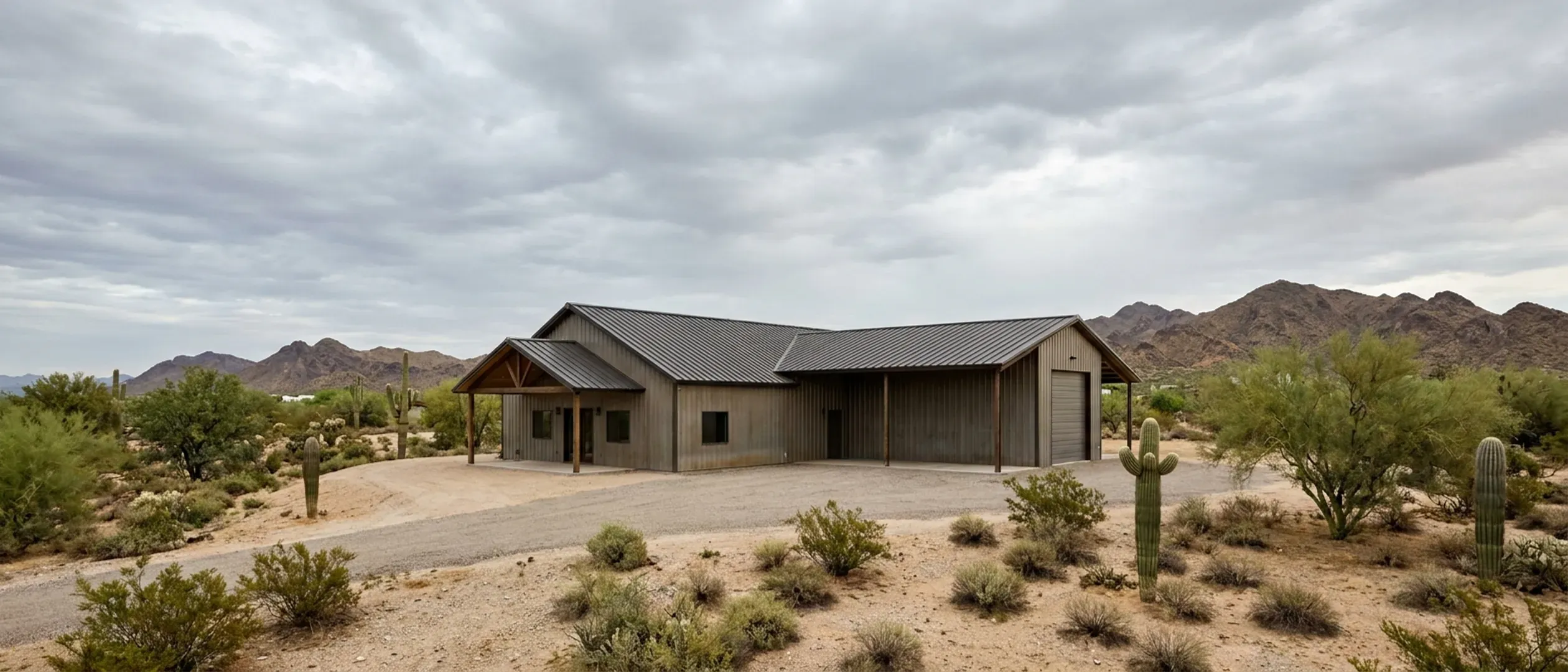
Barndominium vs. House Cost in Arizona: Which Is Cheaper to Build?
A barndominium is not a cheaper house across the board. It changes some parts of the budget and leaves others exactly where they were. NAHB's survey of what it costs to build a home splits construction into eight stages, and only two of them, framing and the exterior, depend on whether the walls are steel, pole-barn posts or wood studs. This guide goes through each stage, uses Census data for the West to show what custom homes actually cost, and sets out the Arizona costs that do not change with the frame: land, septic, impact fees and cooling.
Figures on this page are cited third-party or government data, not a quote from Arizona Barndominium Builders.
Bottom Line Up Front
- The shell is the part that differs. NAHB's 2024 survey puts framing at 16.6% and exterior finishes at 13.4% of construction cost; together that is $128,492 of the $428,215 average. A steel or pole-barn kit replaces those lines.
- Interior finishes (24.1%) and plumbing, electrical and HVAC rough-ins (19.2%) are 43% of NAHB's construction cost, and they cost the same in any kind of frame.
- In Arizona the address can move a budget more than the frame does: Phoenix's published impact fees for one single-family home run from $5,458 to $37,866 by service area, whatever the house is built from.
What actually moves the number
Framing and roof structure
NAHB's 2024 survey puts framing including the roof at $49,763, trusses at $12,903 and sheathing at $6,513 in an average home. A clear-span steel or pole-barn frame uses fewer, larger members and often no roof trusses in the conventional sense, which is where a barndominium can save.
Exterior walls and roofing
NAHB lists exterior wall finish at $24,450 and roofing at $16,732. Census data show 33% of 2025 contractor-built homes in the West had stucco walls and 37% fiber cement. Metal wall and roof panels replace those finishes, though many owners add stone, wood or stucco accents that add the cost back.
Cooling a tall open volume
NAHB's average HVAC line is $26,938 and insulation $6,992, whatever the frame. Maricopa County's design criteria give a 71.2°F mean annual temperature. A barndominium with high ceilings and a big open room has more air to cool, so insulation and duct design matter as much as in any desert house.
Shop space under the same roof
A barndominium often puts a shop or garage under the main roof. Unfinished shop area carries framing, roofing and a slab but no kitchen, baths or interior finishes, so the combined building costs less per total square foot than a house plus a separate shop.
Where a barndominium can cost less
The savings sit in the stages NAHB calls framing and exterior finishes, and in how much building goes under one roof.
Fewer, larger structural members
A red-iron or pole-barn frame spans wide rooms with a few heavy columns and rafters instead of many studs and trusses. NAHB's framing stage, 16.6% of construction cost, is the line this changes.
Metal roofing and wall panels
Panels go on in large sheets. NAHB's exterior stage, 13.4% of construction cost, covers wall finish, roofing, and windows and doors; the windows and doors ($15,990 in NAHB's average) stay the same either way.
Open plans need fewer interior walls
A clear-span frame needs no interior bearing walls, so the layout can use fewer partitions. Fewer walls mean less drywall, trim and paint, which NAHB counts inside interior finishes.
Shop and living under one roof
One foundation, one roof and one set of exterior walls cover both the home and the shop. The shop's share carries no interior finish cost, which lowers the average cost per square foot of the whole building.
Where it costs the same
Most of a home's cost is inside the walls and under the ground, and a barndominium does not change it.
Kitchens, baths and floors
NAHB lists cabinets and countertops at $19,056, flooring at $15,388, appliances at $7,499 and plumbing fixtures at $7,922. A barndominium kitchen costs what any kitchen costs.
Plumbing, wiring and HVAC
NAHB's rough-in stage, 19.2% of construction cost, covers plumbing ($27,180), electrical ($27,383) and HVAC ($26,938). The trades and the code requirements are the same in a steel building.
Foundation and the ground under it
NAHB puts excavation, foundation, concrete and backfill at $43,002. Census data show 61% of 2025 contractor-built homes in the West on slabs. University of Arizona Cooperative Extension calls caliche a common problem in southern Arizona soils, and it is dug out for either kind of home.
Land, septic and utility runs
The parcel, the county septic permit, a well where there is no water provider and the power line extension are the same for a barndominium or a house. Under APS Service Schedule 3 the utility covers up to $10,000 of a new home's line extension, and the owner pays the rest.
What the West-region numbers say about custom homes
The Census Bureau publishes costs for custom homes built on the owner's land and for homes builders sell. Both are useful when comparing a barndominium with a house.
Custom homes on your own land
Census puts the 2025 contract price for contractor-built homes in the West at $176.87 per square foot at the median and $213.85 on average, land excluded. The Census median contract price for the whole home was $377,200.
Homes builders sell
New homes sold by builders in the West averaged $224.31 per square foot in 2025 and $212.50 at the median, per Census data, before the lot. That price includes the builder's marketing, sales and profit.
Nearly all were wood-framed
Census data show 99% of 2025 contractor-built homes in the West were wood-framed and 1% steel-framed. That means the published per-foot figures describe conventional houses; a steel barndominium is compared against them, not measured by them.
What this means for a comparison
Start from the Census per-foot figure for the finish level you want, then adjust only the framing and exterior lines for a barndominium shell. Leave land, fees, septic and interior finishes where they are.
Resale and appraisal
The cheaper build only pays off if the finished home appraises and sells. That is where a barndominium differs most from a house.
Lenders treat unusual homes case by case
Fannie Mae's Selling Guide says loans on unique or nontraditional housing are eligible provided the appraiser has adequate information to reach a reliable opinion of market value.
Comparable sales do not need to match exactly
The same guide says comparables need not share the subject's design and appeal, and that where truly comparable sales are scarce, the best available may be used if the appraiser documents why.
A big shop can change how the property is read
Fannie Mae asks lenders to give properties with outbuildings special consideration to confirm the property is residential in nature. A large shop is best designed and described as part of the home, not as a farm building.
Where a conventional house is the better value
Inside a subdivision with design rules or on a small city lot, a conventional house may cost the same to build and be easier to appraise and sell. A barndominium's advantages show most on rural land with room for a shop.
Reading this because you are weighing a build? The next step is a plan drawn for your program.
What's different about Arizona
Fees are the same for either kind of home
A.R.S. 9-463.05 lets Arizona cities charge development fees per new home. Phoenix's schedule effective June 23, 2025 totals $5,458 to $37,866 per single-family home by service area, and unincorporated Pinal County's runs from $705 to $3,370. None of those figures depends on whether the frame is steel or wood.
Septic and water do not care about the frame
A rural parcel needs the same county septic permit either way: $270 for a conventional review in Pima County and $757 in Maricopa County on their published schedules. A private well is also the same line for a barndominium or a house.
Snow and frost set the structure in the high country
Flagstaff's design criteria set a 60 psf ground snow load and a 30-inch frost line, against Maricopa County's ground snow load of not applicable and frost depth of 0. A clear-span steel roof built for that load costs more in Flagstaff than in the Valley, and so does a stick-built roof.
Termites and the case for steel
Both Maricopa County's and Flagstaff's design criteria list termite damage as moderate to heavy. A steel frame is not a food source for termites, which is one reason some Arizona owners choose it, though a wood-framed interior or trim can still need treatment.
Pros and cons, honestly
Pros
- The framing and exterior stages, 30% of NAHB's construction cost, are where a steel or pole-barn shell can save.
- Clear spans allow open plans with fewer interior walls.
- Home and shop share one foundation, roof and set of exterior walls.
- A steel frame is not a food source for termites, which both Maricopa County and Flagstaff rate moderate to heavy.
Cons
- Interior finishes and mechanical systems, 43% of NAHB's construction cost, cost the same.
- Fees, septic, water and power are the same bill for either kind of home.
- Appraisals can be harder where there are few comparable sales.
- A tall open volume takes careful insulation and HVAC design in the desert heat.
Are barndominiums cheaper to build than a house in Arizona?
How much does a custom home cost per square foot in Arizona?
Are steel-framed houses common in Arizona?
Will a barndominium appraise for what it cost to build?
Does a barndominium have to meet the same code as a house?
Is a barndominium cheaper to cool in Arizona?
Is a barndominium cheaper than a modular home?
Questions answered? Tell us what you want to build and we will put real numbers against it.
Sources
- NAHB — Cost of Constructing a Home 2024 (Special Study, January 2025) — Table 1: construction cost $428,215; framing 16.6%, exterior 13.4%, rough-ins 19.2%, interior 24.1%; line items
- U.S. Census Bureau — Contract Price per Square Foot of New Contractor-Built Single-Family Houses Started — West 2025: median $176.87, average $213.85
- U.S. Census Bureau — Contract Price of New Contractor-Built Single-Family Houses Started — West 2025: median $377,200
- U.S. Census Bureau — Price per Square Foot of Floor Area, New Single-Family Houses Sold — West 2025: median $212.50, average $224.31
- U.S. Census Bureau — Type of Framing in New Single-Family Houses Completed — West contractor-built 2025: 99% wood, 1% steel
- U.S. Census Bureau — Primary Type of Exterior Wall Material, New Single-Family Houses Completed — West contractor-built 2025: 33% stucco, 37% fiber cement
- U.S. Census Bureau — Type of Foundation in New Single-Family Houses Completed — West contractor-built 2025: 61% slab
- Fannie Mae Selling Guide — B4-1.3-05, Improvements Section of the Appraisal Report — Unique housing types; properties with outbuildings
- Fannie Mae Selling Guide — B4-1.3-08, Comparable Sales
- City of Phoenix — 2025 Development Impact Fee Update, fee schedules by land use, effective 6-23-2025 (PDF)
- Pinal County — Development Fee Schedule, effective December 29, 2020 (PDF)
- Maricopa County — Local Additions and Addenda, 19 September 2022 (PDF) — Design criteria: ground snow load N/A, frost line 0, termite moderate to heavy, mean annual temperature 71.2°F
- City of Flagstaff Building Safety — Building Design Criteria (PDF) — Ground snow load 60 psf; frost line 30 inches; termite moderate to heavy
- Maricopa County Environmental Services — Environmental Health Code, Chapter 1 (rev. 08/19/2026, PDF)
- Pima County DEQ — Review Fees for Onsite Wastewater Treatment Facilities (PDF)
- APS — Service Schedule 3, line extensions (effective March 8, 2024, PDF)
- University of Arizona Cooperative Extension — Managing Caliche in the Home Yard (AZ1281, PDF)
Keep reading
The pages that answer the next question this one raises.
Barndominium cost in Arizona
The full published-data budget: Census cost per square foot, land values, and county and city fees.
Read itBarndominium vs. modular home (and kit)
What a kit, a modular home and a site-built barndominium each include in the price.
Read itBarndominium pros and cons
The trade-offs beyond cost: resale, financing, heat, and living next to a shop.
Read itSteel construction
Red-iron frames and clear spans, the part of the budget where a barndominium differs.
Read itPole barn homes
Post-frame construction, the other common barndominium shell.
Read itWant a real number instead of a range?
Start the survey and tell us about your land and what you want to build. Include the county and parcel ID if you have them, because in Arizona the city or county, the water supply, the septic permit and the impact fees change the budget more than the building does. The survey costs nothing.