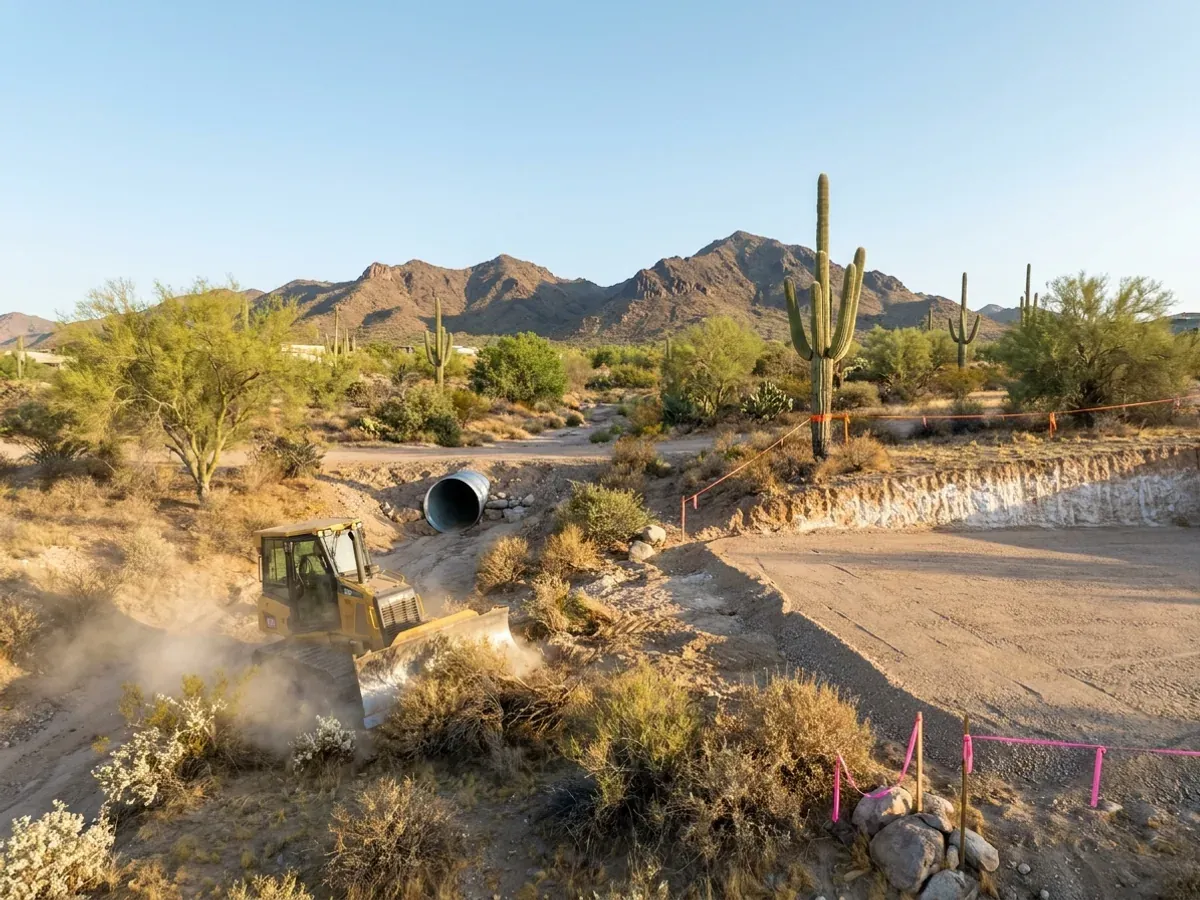
Barndominium Site Preparation in Arizona
Most of what goes wrong on a barndominium goes wrong below the slab. Site preparation is clearing, cut and fill, a compacted pad, drainage, the drive and any wash crossing, and getting water, septic and power to the building. On Arizona land it starts with the ground. The Arizona Geological Survey says expansive and collapsing soils are found throughout the state, from Yuma to the Colorado Plateau, and University of Arizona Extension describes caliche that can be a rock-like layer several feet thick. We test the soil, draw the site and drainage plan, and our crews do the dirt work to it.
Site Preparation: how the work runs
Four stages, in this order. The sequence matters more than it looks: getting the design figures, the soil report, the water and septic answers and the permits settled before anything is fabricated is what keeps an Arizona build from stalling.
Boundary, access, water and authority
Before any dirt moves, four things are settled on paper. Where the lines are, with a land surveyor locating corners that are not already clear. How you get onto the parcel legally, and who issues the driveway permit. Where the water will come from: a city main, a well, or hauled water and storage. And who has authority over the land: a city, a county, or on tribal land the tribal government. Nothing is scheduled until those answers are in hand.
Soil testing: swelling, collapse, caliche and fissures
The Arizona Geological Survey calls soil borings and testing by a geotechnical firm the surest check for expansive soil, and warns that collapsing soil shrinks when wetted or loaded with a building. University of Arizona Extension says caliche restricts water movement, so water perches on top of it. In parts of Cochise, La Paz, Maricopa, Pima and Pinal counties we also check the Survey's earth fissure maps before a pad is placed.
Pad, drainage and the monsoon
Our crews clear the brush, cut and fill the pad to design elevation, and compact the fill in lifts that are tested. Caliche is broken out or ripped where the footings need it. Then the drainage: the National Weather Service warns that flash floods are common in the Southwest and can arrive many miles from the storm. The pad sits above the natural flow lines, and roof water is carried away from the foundation, never left to soak in beside it.
Septic, water and power to the pad
Where the lot has no sewer, the septic system is designed and approved before the house is placed. Under the state's on-site wastewater rules the site is investigated first, with percolation tests in both the primary and the reserve area, and the system needs a Construction Authorization before it is built. Nothing heavy sits over either area, so the septic often decides where the house can go. The well, the water line or the hauled-water storage tank is placed next. Power comes last, run to a service location the utility has approved, with trenches shared where the rules allow.
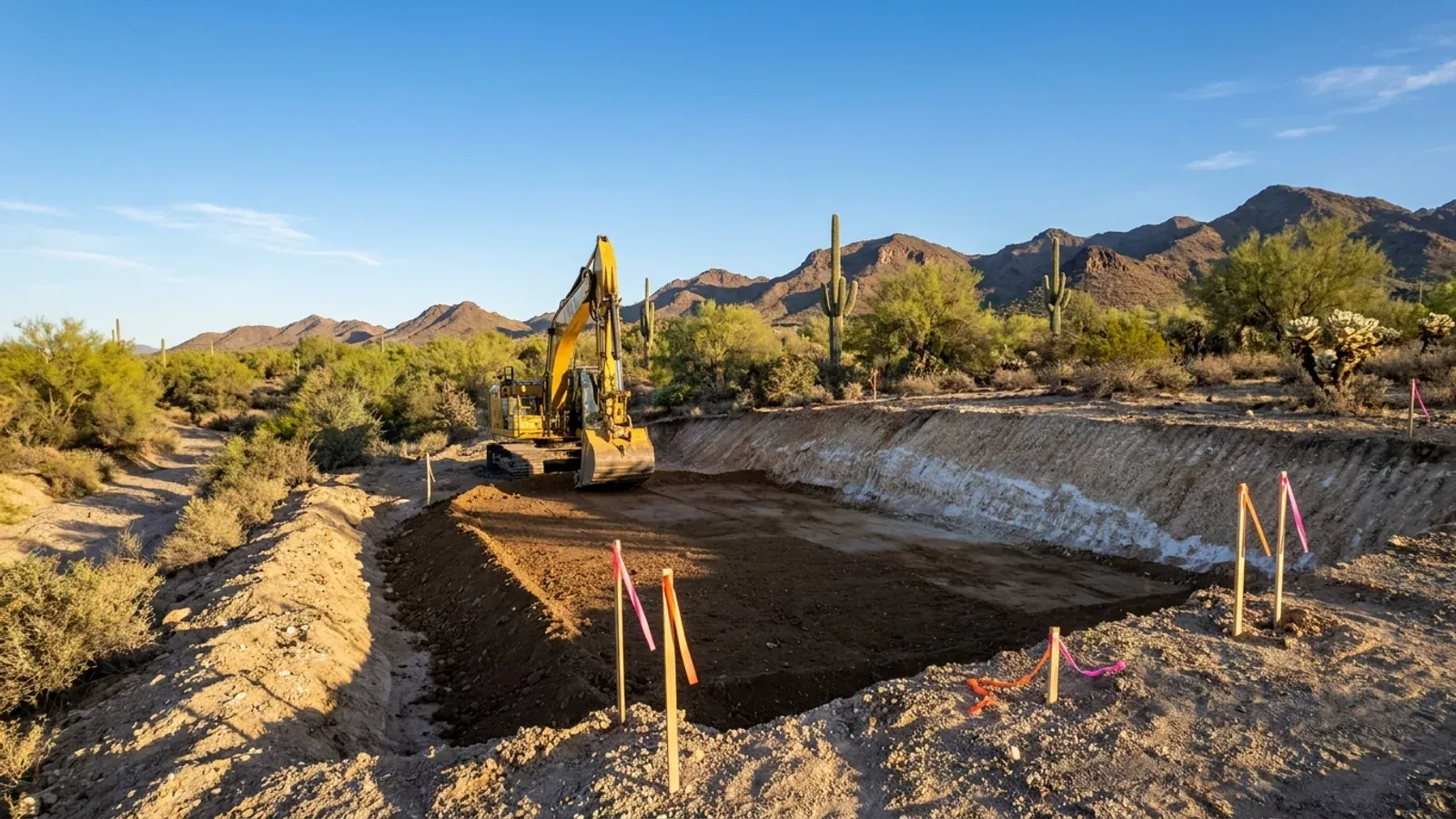
Arizona ground can swell, collapse or crack open
The Arizona Geological Survey says damage to structures in Arizona is commonly related to shrink/swell and collapsing soils, and that monsoon water can swell expansive clay to many times its volume. In five counties it maps earth fissures, cracks from ground subsidence linked to groundwater pumping, which torrential monsoon rains can widen fast. None of that is visible from the road. A soil report and a look at the fissure maps cost little next to a cracked slab.
Site Preparation across Arizona
In Arizona two things change as you cross the state: who has authority over the parcel, and how high it sits. A city, a county and tribal land each answer the permit and zoning questions differently. The low desert around Phoenix, Tucson and Yuma trades snow for heat, termites, monsoon wind and dust; the high country around Flagstaff, Prescott and the White Mountains adds snow load, frost depth and, in forested country, wildfire. Soil, water and septic are settled for every parcel before anything is drawn.
Barndominium builders across Arizona.
Every city and county we serve has its own answer on permits, water, septic and design figures. The service area pages set out what each one publishes.
What actually decides the price
Square footage is the number everyone leads with, and it is rarely the one that moves a barndominium budget. These four do.
-
Caliche and rock
Soft soil digs fast. A hard caliche layer can need a rock bit, a ripper or a breaker, and University of Arizona Extension says it can be several feet thick. It affects footing trenches, septic trenches and utility runs.
-
What the soil report says
Expansive or collapsing soil may need removing and recompacting, imported fill, moisture treatment, or a deeper or stiffened foundation. The report decides, and it is worth having before you buy the land.
-
Drainage and washes
A parcel that takes runoff from uphill, or crosses a wash, needs grading, culverts or a dip crossing and sometimes a flood-zone review. Those costs are invisible on a dry day.
-
Distance to utilities and road
A long drive, a long power run, a deep well or hauled water with storage all add up on rural land. Distance is often the largest single site cost.
Site Preparation in Arizona: common questions
8 questions we get asked most often about building in Arizona. If yours is not on the list, ask it directly.
What does site preparation include?
What is caliche and why does it matter?
Should I test the soil before buying land?
What are earth fissures?
How do you protect the pad from monsoon flooding?
Why keep water away from the foundation?
Where does the water come from on rural land?
Do you handle the septic system?
Keep reading
The pages that answer the next question this one raises.
How Long Does It Take?
Where site work sits in the schedule, including soil testing, septic and the monsoon.
Read itBarndominium Cost in Arizona
Site work is the largest wildcard on any rural build. Here is why.
Read itService Areas
Who permits, and what the land needs, in each Arizona city and county we serve.
Read itReady to put site preparation against a real plan? Start there and the rest follows.
Tell us about the land
Tell us where the parcel is and what you want on it, and we will come back with who has jurisdiction, what the land needs before it can be built on, and how we would build it. Starting the survey costs nothing.