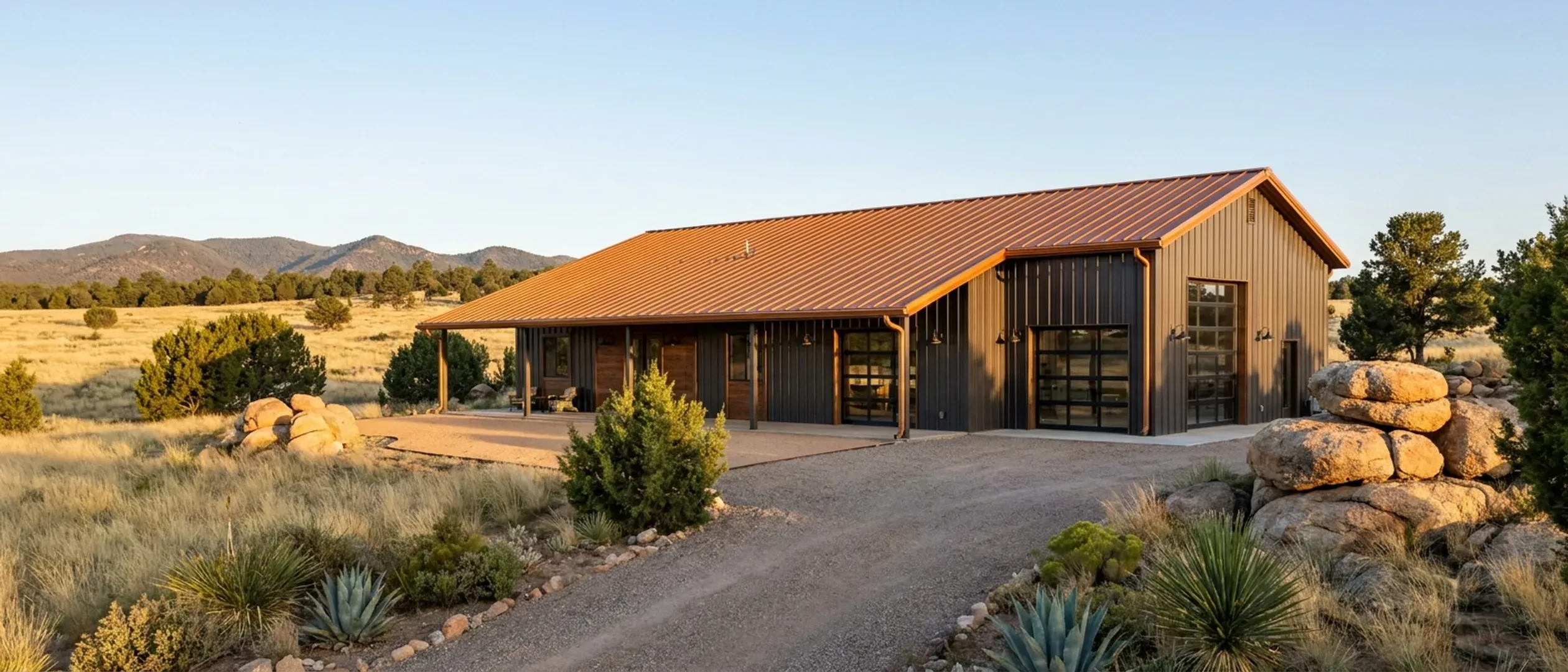
Barndominium Build Timeline in Arizona: Permits, Summer Heat, the Monsoon and Winter at Elevation
The frame of a pole barn or steel barndominium goes up quickly. What decides whether an Arizona project takes one season or two is everything around the frame: whether a home is allowed on the parcel, who issues the building permit and how long its review takes, how the site gets water and wastewater, and when in the year the concrete and the shell land. Arizona has no single permit office. Cities and towns issue building permits inside their limits and counties issue them in unincorporated areas, and each sets its own review times. State law does put some structure around that. Cities must publish how long each kind of permit review takes, and they cannot use noise rules to stop permitted construction early on summer mornings. The weather then adds three things worth planning around: desert heat that the National Weather Service measures in months above 100 degrees, a monsoon season it fixes at June 15 to September 30, and real winter snow in the high country around Flagstaff. This guide sets out the order the work runs in and the timings that the state, the cities and the Weather Service publish.
Figures on this page are cited third-party or government data, not a quote from Arizona Barndominium Builders.
Bottom Line Up Front
- Your permit office sets the review clock. In a city it is the city; in an unincorporated area it is the county. Arizona law (A.R.S. 9-835) makes every city post an overall time frame for each kind of permit. The City of Phoenix's July 2026 report shows a 30-calendar-day goal for the first review of a custom home's plans, and 30 days was the actual average.
- Summer is a working season in the low desert, but the day starts early. Under A.R.S. 9-500.52 a city cannot use a noise rule to stop permitted construction from 5 a.m. to 7 p.m. on business days between May 1 and October 15, and concrete may be poured at least an hour earlier.
- The National Weather Service fixes the monsoon at June 15 to September 30, with outflow winds of 50 mph or more and dense blowing dust. Pour the slab and get the building dried in before it, or plan around it.
Published Arizona review clocks and permit rules
These are the timings and rules that Arizona statutes and one large city publish. None of them includes the time it takes you to put together a complete application.
City permits: a posted overall time frame
A.R.S. 9-835 requires each city and town to post an overall time frame for each type of permit, stating the administrative completeness and substantive review periods separately. The clock stops while the city waits for missing information or corrections from you. The section does not apply to permits issued within seven working days of the initial application.
One comprehensive request for corrections
During the substantive review a city may make one comprehensive request for corrections, which it may amend once to add legal requirements it missed, and it must meet with you within ten working days if you ask. Supplemental requests are limited to issues already raised. If it makes more requests than that on a residential construction permit, or misses its overall time frame, it must refund the review fees and keep processing the application.
Phoenix custom-home plans: 30-day goal
The City of Phoenix's turnaround report for July 2026 shows a 30-calendar-day goal and a 30-day average for the initial review of custom and standard residential building plans. It tells applicants to assume the longer of the two.
No mid-build changes to an approved plan
Under A.R.S. 9-835(N), once a city has approved a residential plan or permit it may not require changes during construction that follows the approved plan, except for a field condition unknown at review, a change you or a later owner request, or a code requirement that was not identified and ruled on before approval.
Summer construction hours
Under A.R.S. 9-500.52, from May 1 to October 15, a city may not use noise rules to prohibit permitted construction between 5 a.m. and 7 p.m. on business days or 7 a.m. and 7 p.m. on Saturdays, and must allow concrete pours to start at least one hour earlier.
County permits: ask for the county's own figures
The county version of the time-frame statute, A.R.S. 11-1605, does not apply to permits needed to build on a residential lot. Maricopa County's permit page offers one free 180-day extension of a permit if the request is received within 180 days of its expiration date. Other counties publish their own terms.
The stages, in the order they usually run
A barndominium on raw Arizona land usually moves through these stages. Several can overlap, but the early ones decide whether the later ones can start.
1. Parcel due diligence
Confirm the parcel is a legal lot, that a home is allowed on it, and whether a city, a county or a tribal government has jurisdiction. On tribal trust land the tribal government has jurisdiction, not the city or county. Find out where water will come from and how wastewater will be handled before you buy, because in Arizona water can decide the whole project. Our legal guide covers the water and septic rules.
2. Zoning and site plan
Setbacks, lot coverage, height and any limits on accessory buildings or a shop's use come from the local zoning code. In a planned community, the association's architectural review is a separate approval with its own timing.
3. Water and wastewater approvals
A well, a water service connection or a hauled-water plan, and a septic permit where there is no sewer. The bedroom count on your plans sets the septic system's size, so settle it before this step.
4. Plans and the building package
The kit or building package, the structural design of the frame and a full set of plans for review. Ask your building department whether it wants structural calculations or engineered drawings for the frame before you order the kit.
5. Permit review
Submit a complete package. Your permit office's posted time frame applies from here, and it stops whenever the office is waiting on you.
6. Site work and foundation
Grading, drainage, utilities and the slab. In the low desert, pour early in the day in summer and aim to finish before the monsoon. In the high country, finish before the ground freezes.
7. Shell erection and dry-in
Frame, roof and wall panels, doors and windows. This is the fast part of a barndominium, and the part most exposed to monsoon wind and dust.
8. Rough-ins and inspections
Electrical, plumbing and mechanical rough-ins, each inspected before it is covered. In the desert, the cooling system is a large part of this stage.
9. Insulation, finishes and final inspection
Insulation to the energy code your jurisdiction has adopted, drywall and finishes, then the final inspection and certificate of occupancy. Keep every permit and inspection record, because lenders, insurers and later buyers ask for them.
Planning around an Arizona year
The low desert and the high country run on nearly opposite calendars, so read these by elevation.
October to April in the low desert: the prime window
Phoenix's average last 100-degree day is October 5 and its average first is May 2. The months in between are the easiest for concrete, steel and roofing in the Valley, Tucson, Yuma and Lake Havasu.
May to mid-October: early starts
State law protects 5 a.m. starts on permitted city projects in this period, and concrete an hour before that. Plan the pour and the heavy lifting for the first hours of the day.
June 15 to September 30: the monsoon
Afternoon and evening storms with strong outflow winds, dust and flash flooding. Keep trenches and open excavations short-lived and aim to have the shell closed in before the season.
Late spring to early autumn in the high country
Around Flagstaff, the White Mountains and the Rim, this is the main building season, with the monsoon in the middle of it. Aim to close in the shell before the first snow.
Winter in the high country: interiors
With Flagstaff's normal snowfall near 90 inches, a dried-in building lets the interior trades keep working when the site itself is closed.
What most often stretches an Arizona schedule
None of these are specific to a barndominium, and most of them are decided before the first shovel.
An incomplete application
Every review clock stops while the permit office waits for missing information. A complete first submittal is the single biggest time saver.
Water
Drilling schedules, a water provider's service terms, or finding late that the parcel has no practical water source. Settle water before you buy.
The monsoon
A storm can wash out grading or fill open trenches overnight, and gusty afternoons stop crane and panel work.
Heat and material handling
Short summer working days, concrete that needs an early start, and metal panels that are too hot to handle by midday.
Association review
In a planned community, the association's design review runs on its own calendar, and it applies on top of the city or county permit.
Changes after the plans are approved
Adding a bedroom changes the septic design, and moving walls or openings can mean revised plans and another review. Settle the plan before the kit is ordered.
Reading this because you are weighing a build? The next step is a plan drawn for your program.
What's different about Arizona
Who issues the permit decides the front end
There is no state office that issues building permits for Arizona homes. Inside a city or town the city's building department does; on unincorporated land the county's planning and development or community development department does. Each sets its own review times, so the first job on any parcel is to find out which office has it. State law then adds a floor under city reviews. Under A.R.S. 9-835 a city must have an overall time frame for each type of permit it issues, split into an administrative completeness review and a substantive review, and must post it on its website. During the substantive review the city may make one comprehensive request for corrections, and if it misses its own overall time frame on a residential construction permit, the statute requires it to refund the review fees. The parallel county statute, A.R.S. 11-1605, excludes permits needed to build on a residential lot, so for county permits the review time is whatever the county itself publishes.
A published example: Phoenix's plan review clock
The City of Phoenix publishes a monthly report of plan review turnaround times. Its report for July 2026 gives a goal of 30 calendar days for the initial review of custom and standard residential building plans and an actual average of 30 days the month before. For plot plans on new homes built from the city's approved standard plans, the goal was 5 days and the average 2. The report notes that times move with workload and project complexity, and tells applicants to plan on the longer of the goal and the average. Corrections add further review cycles. Other cities and counties publish their own figures, and a rural county's may look nothing like these, so ask your own permit office.
Summer heat sets the working day, not the working season
In Phoenix, the National Weather Service's 1991 to 2020 averages put the first 100-degree day on May 2 and the last on October 5, and the first and last 110-degree days on June 11 and August 26. In 2024 Phoenix recorded 143 days at 100 degrees or more and 70 days at 110 or more. Crews in the low desert keep working through the summer by starting early, and state law protects that. Under A.R.S. 9-500.52 a city cannot enact or enforce a noise rule that stops construction done under a valid city building permit between 5 a.m. and 7 p.m. on business days, or 7 a.m. and 7 p.m. on Saturdays, from May 1 to October 15, and it must allow concrete to be poured at least one hour before general construction normally starts. Heat still shortens the useful day, and it matters most for the concrete pour and for handling steel and metal panels that have been sitting in the sun.
The monsoon runs from June 15 to September 30
The National Weather Service office in Phoenix says Arizona's monsoon season officially runs from June 15 through September 30, the period when its hazards are most likely. It lists damaging winds, torrential rain, frequent lightning and dust storms, and says thunderstorm outflows can bring winds of 50 mph or more and very dense blowing dust over open fields and desert. The Flagstaff office says much of northern Arizona receives 40 to 50 percent of its annual precipitation during the monsoon. For a barndominium the practical effects are on grading and trenching, which storm runoff can undo; on the slab pour; and on setting trusses, roof sheets and large wall panels, which are hard to handle safely in gusty wind. Getting the building dried in, roof and walls closed, before July is a sensible target.
Elevation turns winter into a real season
Arizona runs from low desert to high mountains. The National Weather Service office in Flagstaff notes that its forecast area climbs from about 2,000 feet near Black Canyon City to 12,633 feet at Mt. Humphreys, and that snow and ice are common on high-country roads in winter. Its 2024 review puts Flagstaff's normal annual snowfall at 90.1 inches, and 2024 brought 105.5. On a high-country parcel, snow and frozen ground can close the site for weeks, so the ground work and the dry-in belong in the warmer months. In the low desert the reverse is true: late autumn to early spring is often the easiest time to pour concrete and erect steel.
Building it yourself rarely saves time
Arizona's contractor licensing law exempts property owners who build on their own property, doing the work themselves, with their own employees or with licensed contractors, where the home is for the owner's own occupancy and not for sale or rent (A.R.S. 32-1121(A)(5)). The statute treats selling or renting it, or offering to, within one year after completion or the certificate of occupancy as evidence that it was built for sale or rent. It is a legitimate route, but you then carry the scheduling of every trade, inspection and delivery yourself.
Pros and cons, honestly
Pros
- Cities must post their permit review time frames, and a city that misses its own time frame on a residential permit must refund the review fees.
- The shell of a pole barn or steel barndominium goes up quickly once the slab is in, which shortens the time the site is open to weather.
- In the low desert, October to April is a long, dry, mild building window.
- State law protects 5 a.m. summer starts on permitted city projects, with concrete pours allowed at least an hour earlier.
- Once a city approves your plans, it cannot require changes during construction except in the circumstances A.R.S. 9-835(N) lists.
Cons
- Every city and county sets its own review times, and the county statute does not cover permits for building on a residential lot.
- Summer heat shortens the working day and complicates the concrete pour.
- The monsoon falls in the middle of the high country's natural building season.
- At elevation, snow and frozen ground can close a site for part of the winter.
- Water can decide the whole project, and it is settled by the parcel, not the builder.
How long does it take to build a barndominium in Arizona?
Who issues the building permit for a barndominium in Arizona?
Do Arizona cities have to tell me how long a permit review will take?
Can a barndominium be built during an Arizona summer?
When is the monsoon, and does it affect construction?
What about building in Flagstaff or the high country?
Is a barndominium faster to build than a conventional house?
Can I be my own builder to save time?
Questions answered? Tell us what you want to build and we will put real numbers against it.
Sources
- A.R.S. 9-835: Licensing time frames (cities and towns)
- A.R.S. 11-1605: Licensing time frames (counties)
- A.R.S. 9-500.52: Construction; summertime hours
- A.R.S. 32-1121: Exemptions from contractor licensing (owner-builder)
- City of Phoenix: Plan reviews, turnaround times for July 2026
- Maricopa County Planning & Development: Permit actions and activities
- National Weather Service Phoenix: Monsoon awareness
- National Weather Service Phoenix: First and last dates for temperature thresholds
- National Weather Service Phoenix: 2024 climate year in review
- National Weather Service Flagstaff: Northern Arizona monsoon season
- National Weather Service Flagstaff: About our office and northern Arizona
- National Weather Service Flagstaff: Northern Arizona climate statistics for 2024
Keep reading
The pages that answer the next question this one raises.
Are barndominiums legal in Arizona?
Who writes the code, who issues permits, and the water, septic and zoning rules behind this timeline.
Read itPermitting
Working out which office permits your parcel and putting together a complete first submittal.
Read itSite preparation
Grading, drainage, the pad and utilities: the site work the calendar turns on.
Read itBarndominium cost in Arizona
What drives the budget, with every figure attributed to its source.
Read itTell us about your land
Start the survey with your parcel's location and your target move-in date.
Read itWant a real number instead of a range?
Start the survey and tell us about your land and what you want to build. Include the county and parcel ID if you have them, because in Arizona the city or county, the water supply, the septic permit and the impact fees change the budget more than the building does. The survey costs nothing.