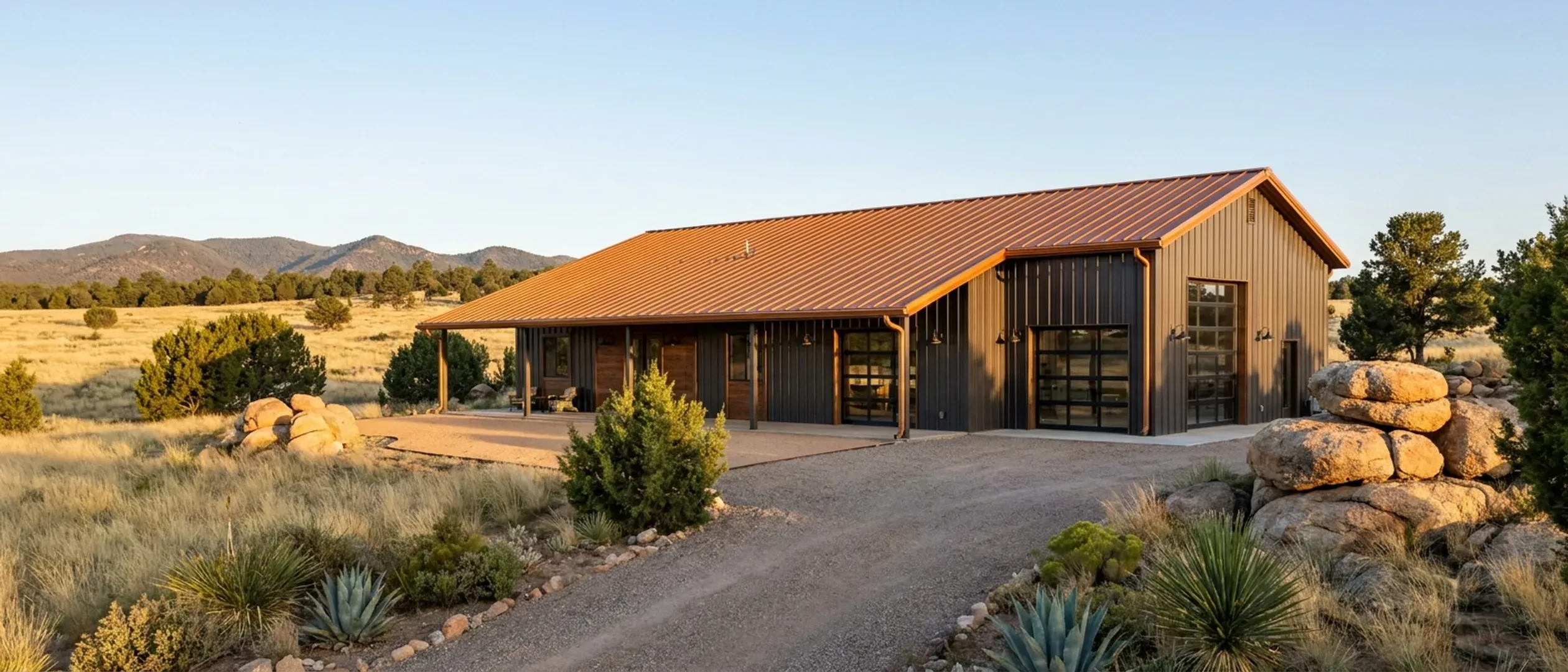
Are Barndominiums Legal in Arizona? Codes, Permits, Zoning, Water, Septic and Contractor Licensing
Can you build a barndominium in Arizona? Yes. Arizona law has no rule against a home with a metal skin, a steel or pole barn frame or a shop under the same roof. What it has instead is a layered system in which almost every rule that matters is set by the place the land sits. There is no statewide residential building code for site-built homes: cities and towns adopt their own codes, and counties may adopt one for their zoned unincorporated areas, with the option of exempting areas zoned rural or unclassified. Zoning is local too. Water is the state's business, through the Arizona Department of Water Resources, and it depends on whether the land is in an Active Management Area and whether it is part of a subdivision. On-site wastewater runs through the Arizona Department of Environmental Quality's general permits, often administered locally. Contractor licensing is statewide, through the Registrar of Contractors. And on tribal trust land, the tribal government has jurisdiction. This guide takes each layer in turn, with the statute or agency that sets it.
Figures on this page are cited third-party or government data, not a quote from Arizona Barndominium Builders.
Bottom Line Up Front
- There is no statewide residential building code for site-built homes in Arizona. Cities adopt codes by reference (A.R.S. 9-802), and a county may adopt one for its zoned unincorporated areas and may exempt areas zoned rural or unclassified (A.R.S. 11-861). The code, the permit and every design figure belong to the jurisdiction.
- Water is set by area. Inside an Active Management Area, new subdivisions need a Certificate of Assured Water Supply, a 100-year supply, under A.R.S. 45-576. Since June 2023 ADWR has not approved new groundwater-based determinations in the Phoenix AMA. A single existing parcel or a lot split of five or fewer lots is not a subdivision.
- Arizona licenses contractors through the Registrar of Contractors, and A.R.S. 32-1101 defines a contractor as synonymous with a builder. Owners who build their own home for their own occupancy, not for sale or rent, are exempt under A.R.S. 32-1121(A)(5).
Water: ADWR, Active Management Areas and subdivisions
In Arizona the water question often decides whether a parcel can take a home at all. The rules depend on where the land is and how it was divided.
Active Management Areas
Arizona's Groundwater Code regulates groundwater most closely inside Active Management Areas. ADWR lists eight: Prescott, Phoenix, Pinal, Tucson, Santa Cruz, Douglas, Willcox and Ranegras Plain. AMA boundaries follow groundwater sub-basins, not county lines, so check the parcel against ADWR's map rather than assuming from the county name.
Assured water supply inside an AMA
Under A.R.S. 45-576, a person offering subdivided land for sale or lease in an AMA must obtain a Certificate of Assured Water Supply before the plat is approved, unless a city, town or private water company designated as having an assured water supply commits to serve it. An assured supply means enough water of adequate quality for at least 100 years.
The Phoenix AMA since June 2023
ADWR's Phoenix AMA groundwater model projected 4.86 million acre-feet of unmet demand, and ADWR says the state will not approve new assured water supply determinations in the Phoenix AMA based on groundwater. Development within existing certificates and designations may continue, and new subdivisions need alternative water sources. This affects new subdivisions, not a buyer building one home on an existing lot served by a designated provider.
Adequate water supply outside an AMA
Outside the AMAs, A.R.S. 45-108 requires the developer of a proposed subdivision to demonstrate the adequacy of its water supply to ADWR. ADWR says an inadequate supply must be disclosed in the public report and in promotional material to first buyers, and some cities, towns and counties require an adequate determination before a final plat is approved (A.R.S. 11-823 lets a county board do so by unanimous vote).
Lot splits are not subdivisions
Arizona defines a subdivision as land divided for sale or lease into six or more lots (A.R.S. 32-2101). A county may review splits of five or fewer lots, any of which is ten acres or smaller, and requires, among other things, a statement on whether each lot has physical access traversable by a two-wheel-drive passenger vehicle (A.R.S. 11-831). A rural parcel created by a lot split does not come with an assured or adequate water determination, so confirm water and access yourself before you buy.
Exempt domestic wells
Under A.R.S. 45-454, a well with a pump capacity of no more than 35 gallons per minute used for non-irrigation purposes is exempt from most of the Groundwater Code. Inside an AMA, uses other than domestic purposes and stock watering are capped at ten acre-feet a year, and in AMAs established on or before July 1, 1994 a new exempt well generally may not be drilled on land within 100 feet of the distribution system of a municipal provider with an assured water supply designation. Outside an AMA, a notice of intention to drill must be filed with ADWR before drilling (A.R.S. 45-596).
Hauled water
Some rural Arizona homes rely on water hauled by truck. A.R.S. 11-823 contemplates water transported by motor vehicle or train for subdivisions. For a single home, check the county's rules and where the nearest fill station is before you rely on it.
Septic: ADEQ's general permits
Most rural barndominium sites have no public sewer, so the on-site wastewater system is part of whether the lot works.
The permit
Conventional septic systems in Arizona fall under ADEQ's Type 4.02 general permit in A.A.C. R18-9: a septic tank with disposal by trench, bed, chamber technology or seepage pit, for less than 3,000 gallons a day of design flow. Alternative systems, such as aerobic units, textile filters and mounds, have their own general permits.
Who administers it
A.R.S. 49-107 lets ADEQ delegate its functions to a county or local agency that accepts the delegation. In practice your application usually goes to the county's environmental or health department. Our location pages name the office for each county where its own site confirms it.
The steps
A site investigation, including percolation testing at several locations where that method is used, then a Construction Authorization before the system is built, then a certificate of completion from the system's designer and a Discharge Authorization before it goes into service. The system is designed on the home's expected flow, so settle the bedroom count first.
Buying land with an existing system
Under A.A.C. R18-9-A316, a person selling a property served by an on-site wastewater system must have a transfer-of-ownership inspection done within six months before the transfer. Ask for the report.
Minimum lot size
Lot-size limits for septic are set locally. Ask the county office that issues the permit before you buy a small parcel.
Zoning, land status and private restrictions
Whether a home is allowed on the land, and what it may look like, is decided before any building code applies.
Zoning is local
Cities zone inside their limits and counties zone unincorporated land. Minimum lot sizes, setbacks, lot coverage, height and limits on accessory buildings or a shop's use all come from the local zoning code, and our location pages cite them where the jurisdiction publishes them.
The agricultural zoning exemption
Under A.R.S. 11-812(A)(2), county zoning may not regulate the use of land or improvements for grazing or general agricultural purposes on a tract of five or more contiguous commercial acres. That protects farming and ranching uses. It does not turn a home into an agricultural building.
Floodplains
Under A.R.S. 48-3613, no development may take place in a delineated floodplain without written authorization from the county flood control district, and A.R.S. 48-3609 requires a home built in a floodplain to have its lowest floor at or above the regulatory flood elevation. Some cities manage their own floodplains.
Wildland-urban interface codes
A.R.S. 11-861(D) lets a county board adopt a wildland-urban interface code. It is optional, county by county, so check whether your county or city has one.
State Trust land
Arizona State Trust land is sold only at public auction to the highest and best bidder, at the county seat, after appraisal and at least ten successive weeks of published notice (A.R.S. 37-236 and 37-237).
Tribal land
On tribal trust land the tribal government has jurisdiction, not the city or county, and city and county permits do not apply. We do not build on trust land under state or county rules.
Covenants and HOAs
In a planned community, the association's declaration can carry covenants on the use, occupancy and appearance of lots, and those can rule out a metal exterior or a large shop whatever the zoning allows. Arizona law does bar an association from prohibiting solar energy devices (A.R.S. 33-1816).
Plans, lenders and buyers
A few more rules shape what you submit and what you can rely on later.
Who may draw the plans
A.R.S. 32-144(A)(3) lets a person who is not a registered architect or engineer design a detached single-family dwelling. Your building department may still require engineered drawings for a steel frame or long clear spans.
Keep the permit file
Lenders, insurers and later buyers ask for permits and final inspections. Where no permit is required, keep the plans and records anyway.
Construction defect claims
Under A.R.S. 12-1361 to 12-1363, before a buyer sues a seller over a construction defect in a dwelling, the buyer must give written notice, and the seller has a right to repair or replace the alleged defect, with an exception for an immediate threat to life or safety.
Seven questions that settle whether your barndominium is legal where you want it
Answer these for the specific parcel, in this order.
1. Is the land private, State Trust, tribal trust or federal land?
That decides who has jurisdiction, and whether you can buy it at all.
2. Is it inside a city or town, or unincorporated?
That decides who issues the building permit and which code applies.
3. Does the zoning allow a home, and a building this size?
Minimum lot size, setbacks, height and any limits on a shop.
4. Does a building code apply there?
In a city, yes. In unincorporated areas, ask the county whether it has adopted a code and whether your zoning is exempt.
5. Where will the water come from?
Is the land in an AMA, is it in a subdivision with an assured or adequate supply, or will it rely on an exempt well or hauled water?
6. Will the lot take a septic system?
Soil testing and the county's lot-size rules decide it.
7. Do covenants allow it?
Read the CC&Rs and ask the association before you buy.
Reading this because you are weighing a build? The next step is a plan drawn for your program.
What's different about Arizona
No statewide residential code: the city or county sets it
No Arizona statute creates a state residential building code for site-built homes. Under A.R.S. 9-802 a city or town may adopt an existing code by reference, and inside city or town limits the city's building department issues residential permits. Under A.R.S. 11-861(A), in any county that has adopted zoning, the board of supervisors may adopt and enforce a building code for the zoned unincorporated areas, and may authorize areas zoned rural or unclassified to be exempt from it. A county code must be one published by a national code organization or adopted by the largest city in that county (11-861(C)). The legislature's own definition of construction codes, in A.R.S. 12-1361, is the codes adopted, amended and enforced by the city, town or county where the dwelling sits. That is why wind speeds, snow loads, frost depths and code editions on this site are always attributed to a named city or county.
Some rural areas may have no building code at all
Because a county code is optional, and a county may exempt areas zoned rural or unclassified, some unincorporated land may carry no building permit requirement. Whether yours does is a question for the county's own development services office, and our location pages answer it where the county publishes it. Separately, A.R.S. 11-865(A)(1) says the county building code article does not apply to construction incidental to farming, stock or poultry raising and similar agricultural uses. That covers agricultural buildings, not a home: a barndominium someone lives in is a dwelling, and it should be permitted as one wherever a permit is required.
What counties cannot require
A.R.S. 11-861(E) bars a county from adopting a code that prevents the owner of a single-family detached home, or a building with no more than two dwelling units, from choosing whether to install fire sprinklers, for codes adopted after December 31, 2009. Under 11-861(G) a county also may not use fire apparatus access road requirements to force sprinklers into a one- or two-family residence or an accessory building such as a barn, private garage, shed or stable. Both limits apply to counties, not to city codes.
Kits are site-built; modular and manufactured homes are not
The one state-level construction code body is for factory-built buildings and manufactured homes: the Office of Manufactured Housing within the Arizona Department of Housing (A.R.S. 41-4002). Arizona's definition of a factory-built building expressly excludes a panelized residential building of open or closed construction (A.R.S. 41-4001(17)(b)). A steel or pole barn barndominium kit erected on site is therefore a site-built home, permitted and inspected by the local building department under its code. Our guide to barndominiums versus modular homes sets out the difference.
Arizona licenses contractors, and the definition is broad
The Registrar of Contractors licenses contractors under A.R.S. Title 32, Chapter 10. A.R.S. 32-1101 says a contractor is synonymous with a builder, and covers anyone who, for compensation, undertakes, offers to undertake or purports to have the capacity to undertake construction of a building, whether doing it themselves or through others, including consultants who represent that they can manage a construction project for the owner. A.R.S. 32-1151 makes it unlawful to act as a contractor without a licence in good standing unless an exemption applies. Specialist work has its own licence classes, including septic systems and well drilling.
Two exemptions that matter for barndominiums
A.R.S. 32-1121(A)(5) exempts property owners who build on their own property, doing the work themselves, with their own employees or with licensed contractors, where the structure is for the owner's own occupancy and not for sale or rent; selling, renting or offering it within one year of completion or the certificate of occupancy is evidence that it was built for sale or rent. A.R.S. 32-1121(A)(4) exempts a supplier that furnishes materials or products and does not install them, and requires that supplier to tell the buyer that installation may also be performed by a licensed contractor whose name and address the buyer may request. Buying a kit is covered by the second; building it yourself is covered by the first.
Pros and cons, honestly
Pros
- No Arizona statute prohibits barndominiums; they are permitted as homes like any other.
- Kits erected on site are site-built homes under the local code, not state-regulated factory-built units.
- Owners may build their own home for their own occupancy under A.R.S. 32-1121(A)(5).
- A non-registrant may design a detached single-family home under A.R.S. 32-144(A)(3).
- Counties may not require fire sprinklers in single-family detached homes under codes adopted after 2009.
- Associations cannot prohibit solar energy devices.
Cons
- Every code, design figure and permit rule is local, so answers do not carry from one county to the next.
- Water rules can rule a parcel out, and new groundwater-based subdivisions in the Phoenix AMA are not being approved.
- Lot splits come with no water determination, so the buyer must confirm water and access.
- Septic suitability and lot-size limits are decided parcel by parcel.
- Covenants in planned communities can exclude metal exteriors or large shops.
- Tribal, State Trust and federal land each follow their own rules.
- Floodplain parcels need flood control district approval and an elevated lowest floor.
Can you build a barndominium in Arizona?
Does Arizona have a statewide building code?
Can I build without a permit in rural Arizona?
Can I permit a barndominium as a barn to avoid the building code?
Do I need a 100-year water supply to build one home?
Can I drill a well for a barndominium in Arizona?
Who issues septic permits in Arizona?
Do I need a licensed contractor to build a barndominium in Arizona?
Can I build a barndominium on tribal land or State Trust land?
Can an HOA stop me building a barndominium?
Questions answered? Tell us what you want to build and we will put real numbers against it.
Sources
- A.R.S. 9-802: Adoption of codes by reference (cities and towns)
- A.R.S. 11-861: County building codes; exemptions; WUI code; sprinklers
- A.R.S. 11-865: Exemptions from the county building code article
- A.R.S. 12-1361: Purchaser dwelling actions, definitions
- A.R.S. 12-1362: Right to repair or replace
- A.R.S. 41-4001: Manufactured housing definitions (factory-built building)
- A.R.S. 41-4002: Office of manufactured housing
- A.R.S. 32-1101: Contractor definitions
- A.R.S. 32-1121: Exemptions from contractor licensing
- A.R.S. 32-1151: Contracting without a licence
- A.R.S. 32-144: Exemptions from registration (design of a detached single-family dwelling)
- A.R.S. 45-576: Assured water supply
- A.R.S. 45-108: Adequate water supply outside AMAs
- A.R.S. 45-454: Exempt wells
- A.R.S. 45-596: Notice of intention to drill
- A.R.S. 11-823: County adequate water supply requirement
- A.R.S. 11-831: Review of land divisions
- A.R.S. 32-2101: Subdivision definition
- A.R.S. 11-812: Restriction on county zoning (agricultural tracts)
- A.R.S. 48-3613: Floodplain development authorization
- A.R.S. 48-3609: Floodplain regulations
- A.R.S. 37-236: Sale of state lands at public auction
- A.R.S. 37-237: Notice of sale of state lands
- A.R.S. 49-107: Delegation of ADEQ functions
- A.R.S. 33-1816: Solar energy devices in planned communities
- ADWR: Active Management Area overview
- ADWR: Assured and adequate water supply overview
- ADWR: Phoenix AMA groundwater supply updates
- A.A.C. R18-9-E302: Type 4.02 general permit (LII mirror)
- A.A.C. R18-9-A316: Transfer of ownership inspection (LII mirror)
Keep reading
The pages that answer the next question this one raises.
Permitting
Finding the office that has your parcel and putting together a complete submittal.
Read itBarndominium build timeline in Arizona
Review clocks, summer work hours, the monsoon and winter at elevation.
Read itBarndominium vs modular home
Site-built, kit, modular and manufactured homes under Arizona law.
Read itService areas
Who issues permits, zoning, water and septic for each Arizona city and county we cover.
Read itTell us about your land
Start the survey with your parcel's location and we will work through these questions with you.
Read itWant a real number instead of a range?
Start the survey and tell us about your land and what you want to build. Include the county and parcel ID if you have them, because in Arizona the city or county, the water supply, the septic permit and the impact fees change the budget more than the building does. The survey costs nothing.