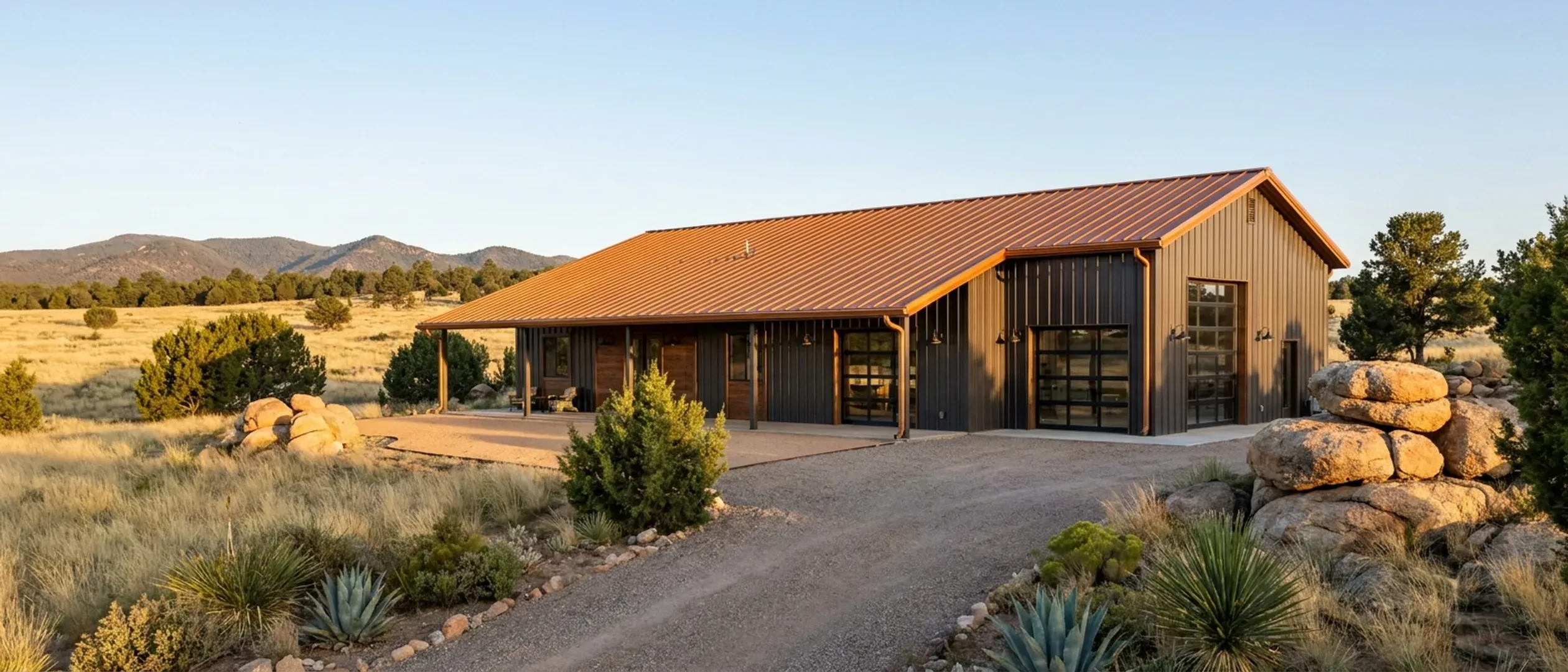
Barndominium Modular Homes in Arizona: Barndominium vs Modular vs Kit
Search for barndominium modular homes or barndo modular homes and you will find four quite different things sold under similar words. A site-built barndominium is framed and finished on your land under your city or county's building permit, whether it starts from a kit or a custom plan. A modular home is built in sections in a factory to adopted building codes and set on a foundation on your site; Arizona law calls it a factory-built building. A manufactured home is built in a factory to the federal HUD code on a permanent chassis. And a barndominium kit, or prefab steel shell, is a package of frame and panels shipped to the site and erected there. Arizona regulates these through different offices. The Arizona Department of Housing's Office of Manufactured Housing covers manufactured homes and factory-built buildings; the local building department covers site-built homes, including kit homes. Lenders and appraisers draw the same line. This guide sets out the differences that matter when you are choosing, with each one attributed to the statute, agency or data source that sets it.
Figures on this page are cited third-party or government data, not a quote from Arizona Barndominium Builders.
Bottom Line Up Front
- A modular home is a factory-built building under A.R.S. 41-4001, and the Arizona Department of Housing's Office of Manufactured Housing enforces its standards. A HUD-code manufactured home is built on a permanent chassis to federal standards. A barndominium, whether from a kit or a custom plan, is built on site under the local building permit.
- Fannie Mae's Selling Guide treats modular, panelized and prefabricated homes as ordinary one-unit homes when they are real property and meet local codes. Manufactured homes have their own rules, including at least two manufactured-home comparable sales in the appraisal.
- The Census Bureau's Manufactured Housing Survey puts the average sales price of a new manufactured home in Arizona at $142,600 in 2025. A barndominium's cost depends on the frame, the finish and the site; our cost guide cites third-party figures for it.
The four options side by side
The words overlap in marketing. The rules do not.
Site-built barndominium
Framed on your land with a pole barn, steel or conventional frame, then finished like any house. Permitted and inspected by the local building department under its adopted code. The widest design freedom: shop bays, clear spans and any floor plan the site allows. This is what we build.
Modular home (Arizona: factory-built building)
Built in sections in a factory to adopted codes, trucked to the site and set on a foundation. The state's Office of Manufactured Housing regulates the factory side. Treated like a site-built house by Fannie Mae when it is real property. Barn-styled modular designs exist, but the sections have to travel by road, which limits how wide an open span can be.
Manufactured home (HUD code)
Built in a factory to federal HUD standards on a permanent chassis. Usually the lowest price per square foot, but often titled as personal property, and financed and appraised under separate rules. Installation is permitted and inspected under the Office of Manufactured Housing's rules.
Barndominium kit or prefab steel shell
A package of frame, roof and wall panels, doors and hardware shipped to the site and erected there. Once it is up, it is a site-built home for permit, inspection, lending and appraisal purposes. Arizona's definition of a factory-built building excludes panelized residential buildings. We supply kits, and we also erect them.
Appraisal and financing
What a lender will value, and how.
Site-built and kit barndominiums
Appraised like any house, from comparable sales. The challenge is finding comparable barndominium sales in the area, not the building's legal category.
Modular homes
Fannie Mae gives modular, prefabricated, panelized and sectional homes the same treatment as site-built housing when they are real property and meet local codes, and does not require the comparables to be factory-built.
Manufactured homes
Fannie Mae requires a HUD data plate and labels, a permanent foundation, at least 12 feet of width and 400 square feet, two or more manufactured-home comparables and a detailed cost approach.
Construction draws
A site-built or kit barndominium is usually financed with a construction loan paid out in stages as the work is done. A factory-built home may follow a different payment schedule, so ask your lender how it handles each; our financing guide covers the options.
What third-party data says about price
We publish no pricing of our own. These figures come from the Census Bureau's Manufactured Housing Survey.
New manufactured homes in Arizona, 2025
The Census Bureau reports an average sales price of $142,600 for new manufactured homes in Arizona in 2025: $98,500 for single-section homes and $160,500 for double-section homes.
Manufactured vs site-built, nationally, 2024
The Census Bureau's cost comparison puts a new manufactured home at $84.45 per square foot in 2024, against $168.86 per square foot for the structure of a new site-built single-family home, excluding land.
What the numbers leave out
A manufactured home's price is only part of the project: land, site work, the foundation, utility connections, water and wastewater all come on top, just as they do for a barndominium. Our cost guide attributes barndominium figures to their sources.
Which one fits
The deciding questions are usually the land, the shop and the loan.
You need a real shop or RV bay
A site-built or kit barndominium. Factory sections cannot deliver a wide clear-span bay attached to the house.
You want the lowest price for living space
A manufactured home usually costs the least per square foot, on the Census Bureau's figures, but it carries separate lending, titling and appraisal rules.
You want a conventional mortgage and a factory schedule
A modular home is treated like a site-built house by Fannie Mae and keeps much of the work in the factory, if a manufacturer offers a design you like.
You want to do part of the work yourself
A kit. Arizona's licensing law exempts owners who build their own home for their own occupancy, not for sale or rent (A.R.S. 32-1121(A)(5)). If you buy only the materials, the same statute requires the seller to tell you that installation may also be performed by a licensed contractor whose name and address you may request.
Reading this because you are weighing a build? The next step is a plan drawn for your program.
What's different about Arizona
Arizona's legal names for factory-built homes
Arizona's manufactured housing statute, A.R.S. 41-4001, sorts homes built off site into three groups. A factory-built building is a residential or commercial building manufactured wholly or in substantial part off site, transported for installation or completion on site, and constructed in compliance with adopted codes, standards and procedures; this is what the industry calls a modular home. A manufactured home is a structure built in accordance with the federal manufactured housing construction and safety standards act of 1974. A mobile home is a structure built before June 15, 1976 on a permanent chassis. The same definition says a factory-built building does not include a manufactured home, or a panelized residential building of open or closed construction.
Who regulates each one
Under A.R.S. 41-4002 the Office of Manufactured Housing, within the Arizona Department of Housing, maintains and enforces standards of quality and safety for manufactured homes, factory-built buildings, mobile homes and accessory structures, and for their installation. It acts as the state inspector for manufactured homes under federal HUD standards. Its board adopts rules for factory-built building construction, plan approvals, installation permits and permanent foundations (A.R.S. 41-4010). A site-built barndominium, including one erected from a kit, is instead permitted and inspected by the city or county building department where it stands, under the code that jurisdiction has adopted.
What makes a manufactured home a manufactured home
The federal definition in 24 CFR 3280.2 describes a structure transportable in one or more sections that is at least 8 body feet wide or 40 body feet long in traveling mode, or 320 square feet or more when erected, built on a permanent chassis and designed to be used as a dwelling with or without a permanent foundation. A barndominium has no chassis and is not built to the HUD code, so it is not a manufactured home unless a manufacturer builds a barn-styled unit to that code.
Lenders draw the same line
Fannie Mae's Selling Guide says factory-built housing such as modular, prefabricated, panelized or sectional housing is not considered manufactured housing and is eligible under the guidelines for one-unit properties, provided it is built of the same quality of materials as site-built housing, is legally classified as real property and conforms to local building codes. Its appraisal section says comparable sales for a modular home need not be the same type of factory-built housing. For a manufactured home, the same guide requires a HUD data plate and certification labels, a permanent foundation with the towing hitch, wheels and axles removed, a width of at least 12 feet and at least 400 square feet of finished area, and an appraisal using at least two manufactured-home comparable sales.
Real property or personal property
A modular or site-built home is real property from the start. Many manufactured homes are not: the Census Bureau's Manufactured Housing Survey found 78 percent of new manufactured homes placed in 2024 were titled as personal property and 18 percent as real estate. In Arizona, A.R.S. 42-15203 lets the owner of a mobile home permanently affixed to land the owner holds file an affidavit of affixture with the county recorder, attaching the Department of Transportation's receipt.
Placement is a zoning question
Where each type may go is set locally. For unincorporated Maricopa County, the county's Planning and Development FAQ says any rural or residential lot may be issued a development permit for one single-wide or multi-sectional manufactured home built after June 15, 1976, on a permanent foundation, and that a multi-sectional manufactured home can be placed anywhere a site-built home is permitted. Cities and other counties set their own rules, and a planned community's covenants may restrict any of the four types. Check the zoning code and the CC&Rs for the parcel before you choose.
Pros and cons, honestly
Pros
- A site-built or kit barndominium allows wide clear spans and an attached shop that factory sections cannot deliver.
- Modular homes are treated like site-built houses by Fannie Mae when they are real property and meet local codes.
- A factory-built home moves much of the work off site and out of the weather.
- Manufactured homes have the lowest average price per square foot in the Census Bureau's data.
- A kit lets an owner-builder take on part of the work under Arizona's owner exemption.
Cons
- Manufactured homes are often titled as personal property and financed and appraised under separate rules.
- Modular section widths are limited by transport, which limits open spans.
- A site-built barndominium's appraisal depends on finding comparable sales nearby.
- Placement rules for manufactured homes vary by city and county, and covenants may exclude any type.
- Factory-built homes still need the full site work, foundation, water and wastewater on your land.
Is a barndominium a manufactured home?
Is a barndominium a modular home?
What are barndominium modular homes?
Who regulates modular and manufactured homes in Arizona?
Is a barndominium kit considered prefab or modular for financing?
Which costs less, a barndominium or a manufactured home?
Can I put a manufactured home anywhere a house is allowed?
Do you build modular or manufactured homes?
Questions answered? Tell us what you want to build and we will put real numbers against it.
Sources
- A.R.S. 41-4001: Manufactured housing definitions
- A.R.S. 41-4002: Office of manufactured housing; purpose
- A.R.S. 41-4010: Powers and duties of the board
- A.R.S. 42-15203: Affidavit of affixture
- A.R.S. 32-1121: Exemptions from contractor licensing
- 24 CFR 3280.2: Definitions (manufactured home)
- Fannie Mae Selling Guide B2-3-02: Special property eligibility, factory-built housing
- Fannie Mae Selling Guide B4-1.4-02: Factory-built housing, modular, prefabricated, panelized or sectional
- Fannie Mae Selling Guide B4-1.4-01: Factory-built housing, manufactured housing
- U.S. Census Bureau: Manufactured Housing Survey annual data (average sales price by state; site-built vs manufactured)
- Maricopa County Planning & Development: Manufactured housing FAQs
Keep reading
The pages that answer the next question this one raises.
Barndominium kits
Frame, roof and wall packages shipped to your site, and what comes in the kit.
Read itBarndominium cost in Arizona
What drives the budget, with every figure attributed to its source.
Read itBarndominium financing
Construction loans, appraisals and what lenders ask for.
Read itAre barndominiums legal in Arizona?
Codes, permits, zoning, water and septic for a site-built barndominium.
Read itTell us about your land
Start the survey and we will talk through kit, custom plan or turnkey build.
Read itWant a real number instead of a range?
Start the survey and tell us about your land and what you want to build. Include the county and parcel ID if you have them, because in Arizona the city or county, the water supply, the septic permit and the impact fees change the budget more than the building does. The survey costs nothing.