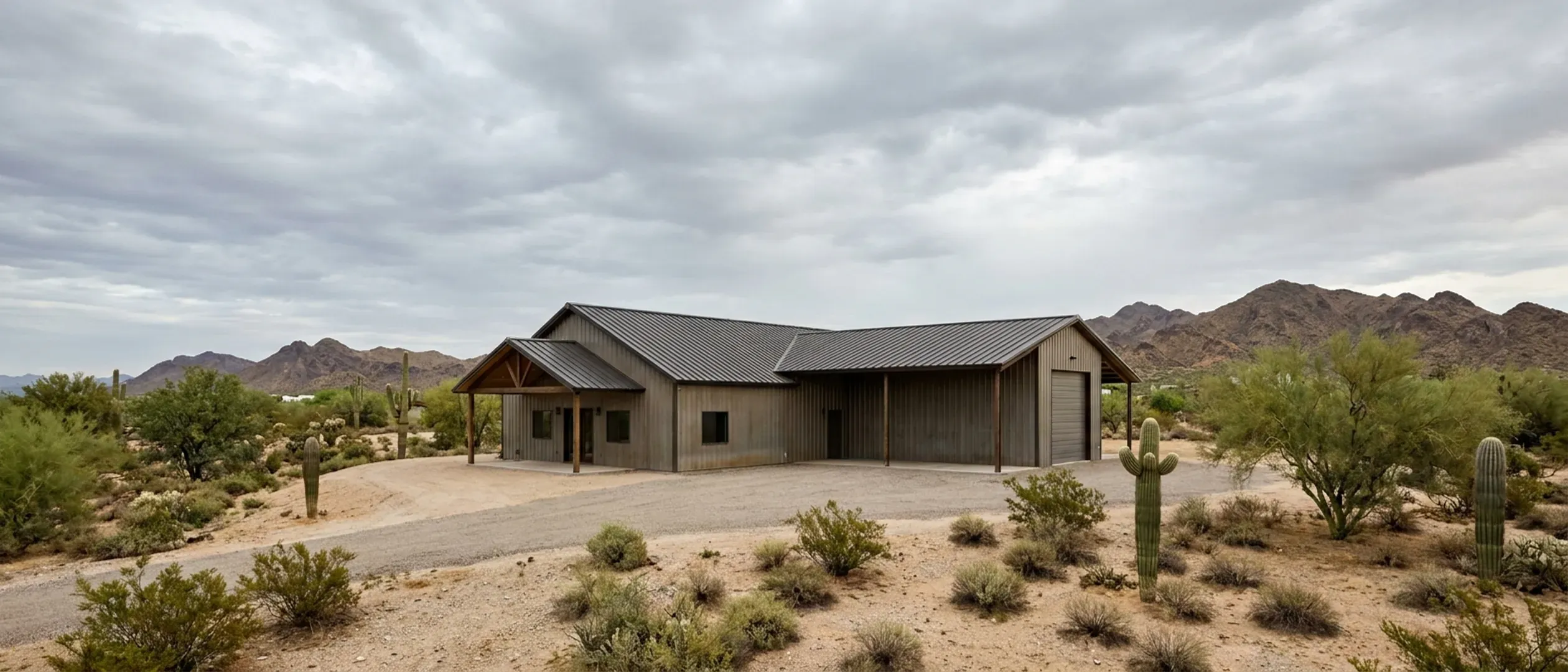
Barndominium Financing in Arizona: Construction Loans, USDA, FHA and VA
Most barndominiums are financed the way any custom home on your own land is: a construction loan that pays the builder in draws and then becomes a normal mortgage. What makes a barndominium different is the appraisal, because there are fewer similar homes to compare it with, and in Arizona a handful of costs arrive before the first draw. This guide covers the loan types with the rules their own agencies publish, what Census data show about how custom homes in the West are paid for, and the Arizona items to plan for. We do not quote interest rates; lenders set those daily.
Figures on this page are cited third-party or government data, not a quote from Arizona Barndominium Builders.
Bottom Line Up Front
- A single-closing construction-to-permanent loan is the usual route. Fannie Mae's Selling Guide caps the construction period at 12 months per period and 18 months in total before the loan converts to a permanent mortgage.
- USDA, FHA and VA can all finance new construction, each with conditions: USDA's guaranteed program is for a principal residence within income limits and will not guarantee buildings designed largely for a business, and FHA's construction-to-permanent program requires a licensed general contractor as the builder.
- In Arizona, some money is due before the first draw: Pinal County collects impact fees when the building permit is issued, and APS requires any line extension cost above its $10,000 allowance to be paid when the agreement is signed.
What actually moves the number
One closing or two
A single-closing loan sets the permanent mortgage terms before construction starts and converts automatically when the home is complete. Fannie Mae's Selling Guide requires the appraisal to be dated no more than four months before the note date, with a completion report once the home is built.
The appraisal
Fannie Mae treats unique or nontraditional homes as eligible if the appraiser has enough information for a reliable value, and accepts comparables that are not truly comparable where better ones are scarce, if the appraiser explains why. Rural Arizona parcels with few recent sales make this the step to plan for.
The shop
Fannie Mae asks lenders to confirm that a property with significant outbuildings, such as large barns or storage, is residential in nature. USDA's guaranteed program will not fund buildings designed largely for a business. Design and describe the shop as part of the home.
Cash before the first draw
Land, plans, permit fees, impact fees and utility deposits often come before construction funds flow. Census data show 32% of 2025 contractor-built homes in the West were paid for in cash, so a large share of owners fund at least part of the build themselves.
How custom homes in the West are actually paid for
The Census Bureau records how contractor-built homes, the ones built on the owner's land, were financed.
Mostly conventional loans
Census data show 65% of contractor-built homes started in the West in 2025 were financed with conventional loans. That is the main route for a barndominium too.
Almost a third paid cash
Census data show 32% of those homes were paid for in cash, a far larger share than for homes bought from builders. Many owners combine savings or land equity with a smaller loan.
FHA and VA were rare
Census data put FHA-insured loans at about 1% and VA-guaranteed loans at about 2% of 2025 contractor-built starts in the West. Both programs finance construction, but few owner-land builds use them.
What the loans had to cover
The Census median contract price for a West contractor-built home in 2025 was $377,200, land excluded, and the average $535,700. The loan also has to carry fees and site costs that the contract price leaves out.
Construction-to-permanent loans
The single-closing construction-to-permanent loan is the product built for a custom home on land you own.
One set of documents
Fannie Mae's Selling Guide describes a single closing in which the loan documents set the permanent terms, so the construction loan converts to a long-term mortgage when construction is complete. Fannie Mae buys the loan only after it converts.
The construction clock
Fannie Mae limits the construction period to no more than 12 months at a time and 18 months in total. A barndominium with a long permit or well-drilling lead time should have those done before closing.
Draws and inspections
Construction funds are released in stages as work is inspected. Ask each lender how many draws it allows, who inspects, and how long a draw takes, because the builder is paid on that schedule.
Land you already own
FHA's handbook allows its construction-to-permanent program on land the borrower owns or buys at the construction loan closing. Equity in owned land can count toward what the lender requires.
USDA, FHA and VA
Each federal program publishes its own conditions. These are the ones that matter most for a barndominium.
USDA guaranteed loans
USDA's rules for guaranteed loans (7 CFR 3555) allow funds for the construction of a new dwelling and define a combination construction and permanent loan. The home must be the principal residence, household income must be within the program's moderate-income limit, and the dwelling must be modest, decent, safe and sanitary.
USDA eligibility is by address
USDA's rural area eligibility is set by location under the Housing Act of 1949, and USDA publishes an eligibility lookup by address. Check the exact parcel before planning around a USDA loan, because eligibility can change between neighboring areas.
FHA construction to permanent
HUD Handbook 4000.1 describes FHA's construction-to-permanent program as a single closing before construction starts. The borrower must contract with a builder who is a licensed general contractor, and may act as the general contractor only if also licensed.
VA
VA says an eligible veteran's VA-backed purchase loan can be used to build a new home. The lender and builder must meet VA's requirements, so confirm early that the lender makes VA construction loans.
The appraisal: the step to plan for
A lender lends against appraised value, not cost. For a barndominium this is the step that most often needs preparation.
Unique homes are eligible, case by case
Fannie Mae names earth houses, geodesic domes and log houses as examples of unique housing that is eligible when the appraiser has adequate information for a reliable opinion of market value. A barndominium is appraised on the same footing.
Comparable sales do not have to match
Fannie Mae says comparables need not share the subject's design and appeal, and that where truly comparable sales are scarce the best available may be used if the appraiser documents why.
Large outbuildings raise a question
Fannie Mae distinguishes minimal outbuildings from significant ones, such as large barns or storage areas, which may suggest a property is agricultural. The lender must decide the property is residential. A shop drawn and finished as part of the home avoids that question.
Give the appraiser what they need
Provide the plans, a line-item budget, finish specifications and any nearby sales of barndominiums or custom metal-building homes. The appraisal is dated no more than four months before closing on a Fannie Mae single-closing loan, so have this ready early.
Reading this because you are weighing a build? The next step is a plan drawn for your program.
What's different about Arizona
Impact fees are due at the permit
Pinal County's impact fee page says its development fees are assessed and collected at the time of building permit issuance; its 2020 schedule runs from $705 to $3,370 per single-family home. Phoenix's 2025 schedule totals $5,458 to $37,866 by service area. Ask the lender whether these can be paid from the loan or must come from cash.
Line extension money is due at signing
Under APS Service Schedule 3 (effective March 8, 2024), the utility covers up to $10,000 of a new home's line extension, and payment for costs above that is due when the applicant signs the line extension agreement, before APS begins work.
Transaction privilege tax sits inside the contract
A.R.S. 42-5075 taxes construction contracting on 65% of the contract's gross proceeds, after deducting the land price. Make sure the construction budget the lender approves includes the tax if the builder's price does.
Septic approval is part of completion
On a septic lot, the county permit process runs from site investigation and percolation testing to a construction authorization and then a discharge authorization for the finished system. Build that sign-off into the schedule a construction-to-permanent loan runs on.
Can you get a mortgage for a barndominium in Arizona?
Can a USDA loan be used to build a barndominium?
Is my land in Arizona eligible for USDA financing?
Can I use an FHA loan to build a barndominium?
Can I use a VA loan to build a barndominium?
Will a big shop affect my loan?
How long can construction take on a construction-to-permanent loan?
What do I need to pay before the loan funds construction?
Questions answered? Tell us what you want to build and we will put real numbers against it.
Sources
- Fannie Mae Selling Guide — B5-3.1-02, Conversion of Construction-to-Permanent Financing: Single-Closing Transactions — 12-month / 18-month construction limits; appraisal no more than four months before the note date
- Fannie Mae Selling Guide — B4-1.3-05, Improvements Section of the Appraisal Report — Unique housing types; properties with outbuildings
- Fannie Mae Selling Guide — B4-1.3-08, Comparable Sales
- HUD — Handbook 4000.1, FHA Single Family Housing Policy (revised 08/13/2025), II.A.8.j Construction to Permanent (PDF) — Builder must be a licensed general contractor; land owned or purchased at closing
- VA — VA-backed purchase loan — Uses include 'Build a new home'
- 7 CFR 3555.101 — Guaranteed loans: loan purposes (eCFR)
- 7 CFR 3555.102 — Guaranteed loans: loan restrictions (eCFR)
- 7 CFR 3555.151 — Guaranteed loans: eligibility requirements (eCFR)
- 7 CFR 3555.10 — Definitions, including combination construction and permanent loan (eCFR)
- USDA — Income and Property Eligibility site
- U.S. Census Bureau — Contract Price of New Contractor-Built Single-Family Houses Started, and Starts by Type of Financing — West 2025: conventional 65%, cash 32%, FHA 1% and VA 2%; median contract price $377,200, average $535,700
- Pinal County — Impact Fees — Development impact fees 'are assessed and collected at the time of Building Permit Issuance'
- Pinal County — Development Fee Schedule, effective December 29, 2020 (PDF)
- City of Phoenix — 2025 Development Impact Fee Update, fee schedules by land use, effective 6-23-2025 (PDF)
- APS — Service Schedule 3, line extensions (effective March 8, 2024, PDF) — Section 3.1(A): payment due when the line extension agreement is signed
- A.R.S. 42-5075 — Prime contracting classification
Keep reading
The pages that answer the next question this one raises.
Barndominium cost in Arizona
The published-data budget the loan has to cover, fee by fee.
Read itHow big a barndominium your budget builds
From a loan amount to square feet, with site costs set aside first.
Read itBarndominium build timeline
How long each stage takes, against the construction loan's clock.
Read itAre barndominiums legal in Arizona?
Permits, septic and water rules that sit behind the lender's conditions.
Read itTell us about your land
Start the survey with your parcel and budget, and we will follow up.
Read itWant a real number instead of a range?
Start the survey and tell us about your land and what you want to build. Include the county and parcel ID if you have them, because in Arizona the city or county, the water supply, the septic permit and the impact fees change the budget more than the building does. The survey costs nothing.