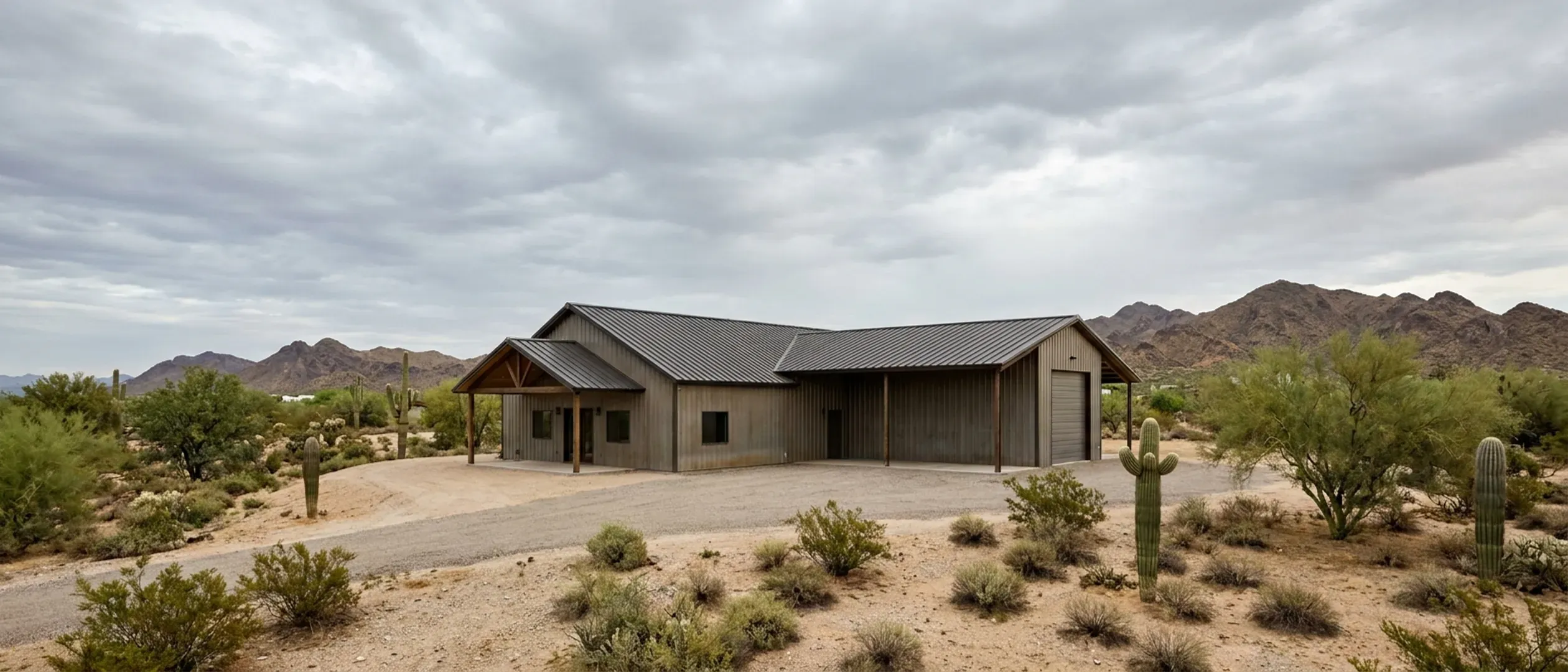
How Big a Barndominium Can You Build in Arizona for Your Budget?
The honest way to size a barndominium is to work backward: start from the total you can spend, take out the land and everything the land needs, and divide what is left by a published cost per square foot. This guide does that with the Census Bureau's 2025 figures for custom homes built on the owner's land in the West, and with the Arizona fees and site costs that come out of the budget before the first wall goes up. The results are arithmetic on published numbers, not our price.
Figures on this page are cited third-party or government data, not a quote from Arizona Barndominium Builders.
Bottom Line Up Front
- At the Census Bureau's 2025 West contract rates ($176.87 per square foot median, $213.85 average), a $300,000 building budget covers about 1,400 to 1,700 finished square feet, and $500,000 covers about 2,340 to 2,830.
- Take the site costs out first. In Arizona they include a county septic permit ($757 for a conventional system in Maricopa County), any city impact fees (up to $37,866 per home on Phoenix's schedule) and the part of a power line extension above the utility's allowance.
- Unfinished shop space costs far less per foot than living space, so size and price the shop as its own line.
What actually moves the number
Land and access come off the top
USDA puts Arizona farm real estate at $4,300 an acre in 2026, an average that mixes ranchland with irrigated farmland. A driveway, grading and a power line to a remote parcel all come out of the same budget as the house.
Septic and water
Off a sewer, the septic permit and system come first. The county review fee alone is $270 in Pima County and $757 in Maricopa County for a conventional system; the tank, field and installation are priced by the installer. A well, where there is no water provider, is its own line.
Fees that scale by address
Phoenix's development impact fees effective June 23, 2025 total $5,458 to $37,866 per single-family home by service area. Unincorporated Maricopa County's building permit on a $400,000 valuation is about $2,674 plus about $1,738 in plan review on its published table.
Finish level sets the rate
The Census median ($176.87) and average ($213.85) per square foot are two finish levels, not a floor and a ceiling. NAHB's 2024 survey puts interior finishes at 24.1% of construction cost, so plain finishes move a budget toward the median and custom ones past the average.
The method, step by step
Four steps turn a total budget into a realistic floor area.
1. Start from the total you can spend
Use the total you can finance plus cash, including land if you do not own it yet. A lender will size a construction-to-permanent loan on the finished home's appraised value, so keep a margin rather than spending to the last dollar.
2. Subtract the land and the site
Take out the parcel, driveway, grading, septic, well or water connection, the power line cost above the utility's allowance, and the permit and impact fees for the address. What remains is the building budget.
3. Divide by a published cost per square foot
Divide the building budget by the Census 2025 West contract rate: $176.87 per square foot for a plain finish, $213.85 for a well-finished home. The two answers bracket the heated area the budget builds.
4. Adjust for the plan
Shop space, covered porches and a simple rectangular footprint stretch a budget. Many bathrooms, a complex roof or a tall ceiling over the whole living area shrink it.
What common building budgets cover
Each line divides a building budget, after land and site costs, by the Census 2025 West contract price per square foot: $213.85 average first, $176.87 median second.
$100,000 building budget
About 470 to 565 finished square feet at the Census West rates. A budget this size usually means a small cabin-style plan, owner finish work, or a kit shell with the interior finished over time.
$200,000 building budget
About 935 to 1,130 finished square feet at the Census West rates: a compact one- or two-bedroom plan, or a smaller finished home inside a larger shell.
$300,000 building budget
About 1,400 to 1,700 finished square feet at the Census West rates, enough for a two- or three-bedroom plan with a modest shop.
$500,000 building budget
About 2,340 to 2,830 finished square feet at the Census West rates, which brackets the West's 2025 median contractor-built home of 2,354 square feet.
How big custom homes in the West actually are
Census data on contractor-built homes completed in the West in 2025 show what people on their own land actually built.
The middle of the market
The median West contractor-built home completed in 2025 had 2,354 square feet and the average 2,751, per Census data. The median lot was 43,846 square feet, about an acre.
Smaller homes
Census data show 29% of those homes were under 1,400 square feet and another 9% between 1,400 and 1,799. A small barndominium is not an outlier among custom homes in the West.
Larger homes
Census data show 15% were between 3,000 and 3,999 square feet and 20% were 4,000 or more. At the Census median rate, 3,000 square feet is about $531,000 before land.
Bedrooms
Census data show 28% of 2025 West contractor-built homes had two bedrooms or fewer, 35% had three and 37% had four or more. Bedroom count also sizes the septic system, so decide it before the septic design.
Getting more building from the same budget
The plan choices that stretch a budget most are the ones that reduce plumbing, finish area and air volume.
Keep the wet rooms together
Kitchen, baths and laundry grouped along one wall share plumbing runs. NAHB's 2024 survey puts plumbing rough-in at $27,180 in an average home, and shorter runs cost less.
Finish in phases
A shell with part of the interior finished and part left as shop or future space lets the budget cover more roof now. Confirm with the building department what must be complete for occupancy.
Watch the ceiling height
A barndominium's tall walls are part of its appeal, but a lower ceiling over bedrooms and baths cuts the volume to cool in the desert and the wall area to insulate and finish.
Plan the shop as its own line
Unfinished shop area has a slab, walls and roof but no kitchens, baths or interior finishes. Price it separately, not at the living-area rate, and the house budget goes further.
Reading this because you are weighing a build? The next step is a plan drawn for your program.
What's different about Arizona
A cooling load you size for
Maricopa County's design criteria give a 71.2°F mean annual temperature. Every extra foot of ceiling height adds volume to cool, so in the low desert a lower ceiling in the living area can buy more floor area for the same total cost.
High-country structure costs more per foot
Flagstaff's design criteria set a 60 psf ground snow load and a 30-inch frost line; Maricopa County lists ground snow load as not applicable and frost depth as 0. A frame and footings built for snow and frost cost more, so the same budget builds somewhat less area at elevation.
Power: the first $10,000 of a line extension
Under APS Service Schedule 3, the utility covers up to $10,000 of the cost of extending service to a new single-family home, and the applicant pays the rest before work begins. On a parcel far from a line, that remainder comes out of the building budget.
Transaction privilege tax
Under A.R.S. 42-5075, construction contracting is taxed on 65% of the contract's gross proceeds after the land price is deducted, at the combined rate for the job site. If a bid excludes it, set that tax aside before dividing by a cost per square foot.
How big of a barndominium can I build for $100,000 in Arizona?
How big of a barndominium can I build for $200,000 in Arizona?
How big a barndominium can I build for $500,000?
What cost per square foot should I use in Arizona?
Does shop space count as square footage?
Should I build smaller and finish later?
What size are most new custom homes in the West?
Questions answered? Tell us what you want to build and we will put real numbers against it.
Sources
- U.S. Census Bureau — Contract Price per Square Foot of New Contractor-Built Single-Family Houses Started — West 2025: median $176.87, average $213.85
- U.S. Census Bureau — Square Feet of Floor Area in New Single-Family Houses Completed — West contractor-built 2025: median 2,354, average 2,751; 29% under 1,400; 20% 4,000 or more
- U.S. Census Bureau — Number of Bedrooms in New Single-Family Houses Completed — West contractor-built 2025: 28% two or fewer, 35% three, 37% four or more
- U.S. Census Bureau — Lot Size of New Single-Family Houses Completed — West contractor-built 2025: median lot 43,846 sq ft
- NAHB — Cost of Constructing a Home 2024 (Special Study, January 2025)
- USDA NASS — Land Values 2026 Summary (July 2026, PDF) — Arizona farm real estate $4,300 per acre
- City of Phoenix — 2025 Development Impact Fee Update, fee schedules by land use, effective 6-23-2025 (PDF)
- Maricopa County Planning and Development — Summary of the Fee Schedule, June 2024 (PDF) — Table 1-A building permit fees; plan review 65%
- Maricopa County Environmental Services — Environmental Health Code, Chapter 1 (rev. 08/19/2026, PDF)
- Pima County DEQ — Review Fees for Onsite Wastewater Treatment Facilities (PDF)
- APS — Service Schedule 3, line extensions (effective March 8, 2024, PDF)
- Maricopa County — Local Additions and Addenda, 19 September 2022 (PDF)
- City of Flagstaff Building Safety — Building Design Criteria (PDF)
- A.R.S. 42-5075 — Prime contracting classification
Keep reading
The pages that answer the next question this one raises.
Barndominium cost in Arizona
Where the per-square-foot figures come from, and the county and city fees to set aside first.
Read itFinancing a barndominium in Arizona
How construction-to-permanent loans, USDA, FHA and VA size the budget you start from.
Read itBarndominium floor plans
Plans by size and bedroom count, to match against the square footage your budget covers.
Read itSmall barndominium plans
Compact layouts for the smaller budgets above.
Read itBarndominium kits
A shell now and interior finish over time, one way to stretch a smaller budget.
Read itWant a real number instead of a range?
Start the survey and tell us about your land and what you want to build. Include the county and parcel ID if you have them, because in Arizona the city or county, the water supply, the septic permit and the impact fees change the budget more than the building does. The survey costs nothing.