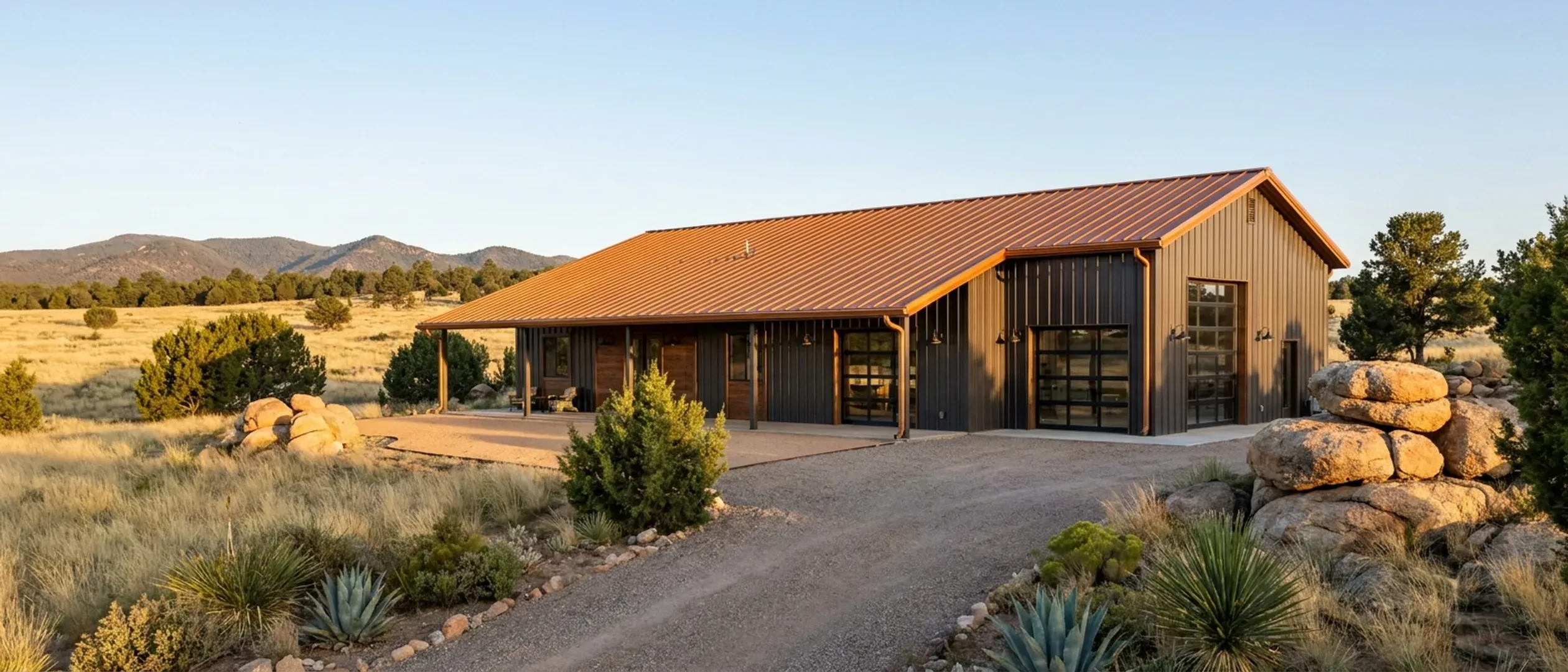
Barndominium Pros and Cons in Arizona: Heat, Termites, Monsoon Wind, Resale and HOA Rules
A barndominium is not one kind of building. It is a look and a floor plan, a big open living space and often a shop under one wide roof, built with a pole barn frame, a steel frame, or conventional framing dressed to look like a barn. Arizona puts unusual pressure on each of those choices. The University of Arizona's Cooperative Extension calls termites the state's leading urban pest, which is a real argument for steel. The National Weather Service records Phoenix summers with months of 100-degree days, which is a real argument for getting the insulation and roof right. The monsoon brings outflow winds of 50 mph or more and dense dust, and the high country gets proper snow. Then there are the questions that have nothing to do with weather: whether an appraiser can find comparable sales, and whether the land you want sits in a planned community whose covenants control what a house may look like. This guide sets out the pros and cons as they actually play out in Arizona, and what each one depends on.
Figures on this page are cited third-party or government data, not a quote from Arizona Barndominium Builders.
Bottom Line Up Front
- Steel framing takes the structural wood out of reach of termites, which the University of Arizona's Cooperative Extension calls the leading urban pest in Arizona. Doors, trim, cabinets and drywall paper are still cellulose, so a steel frame reduces the risk but does not end it.
- The metal skin is not the problem in desert heat; the assembly behind it is. In 2024 Phoenix recorded 143 days at 100 degrees or more (National Weather Service), so insulation, air sealing, roof color and cooling design matter more than on almost any other house type.
- In a planned community, the association's declaration can set covenants on a home's appearance. Read the CC&Rs before you buy the lot. Arizona law does stop an association from banning solar panels (A.R.S. 33-1816).
Three different buildings, one word
Most of the pros and cons depend on which of these you actually build.
Pole barn (post-frame) construction
Large posts set in the ground or on piers, with girts and purlins carrying the metal skin. Wide clear spans and a lower cost for the shell. The posts and framing are usually wood, so termite protection matters as much as it does on any wood-framed house.
Steel-frame construction
A red-iron or light-gauge steel frame on a concrete slab. The strongest answer to Arizona's termites and very wide clear spans for a shop. It needs careful detailing to stop the frame conducting heat through the insulation, and usually engineered drawings for the frame.
Conventional framing with barn styling
A wood-framed house with a barn roofline and metal siding. The easiest to appraise and insure, because it is a conventional house underneath, but it keeps the termite exposure of any wood-framed house.
The advantages, and what they depend on
Each of these is real, and each has a condition attached.
Termite resistance from a steel frame
With a steel frame, termites cannot eat the structure. They can still reach interior wood and paper through slab cracks and pipe penetrations, which is where the University of Arizona's guide tells homeowners to look.
A shop and a house under one roof
An RV bay, a workshop or equipment storage attached to the living space, without a second building. Check the zoning code for how it treats a shop's size and any business use.
Clear spans and a flexible plan
Few or no interior load-bearing walls, so the plan can open up and change later. Wide spans need a frame and roof designed for the loads where you build.
A fast shell
Once the slab is poured, a kit frame and metal skin go up quickly, which shortens the time the site is exposed to monsoon storms.
A durable, low-maintenance exterior
Metal roofing and siding do not need repainting on the schedule of stucco or wood, and a metal roof suits the solar panels Arizona covenants cannot ban.
Plans for a single-family home
Arizona's registration law lets a person who is not a registered architect or engineer design a detached single-family dwelling (A.R.S. 32-144(A)(3)). Your building department may still require engineered drawings for the frame.
The disadvantages, and how to manage them
None of these rule a barndominium out. All of them cost money if they are ignored.
Heat gain through a metal skin
Managed with continuous insulation or spray foam, a reflective roof, shade on the west and south, and cooling designed for the house rather than guessed.
Thermal bridging in steel frames
Steel conducts heat, so a frame that touches the skin carries heat straight through the insulation. Thermal breaks and continuous insulation outside the frame solve it.
Wind loads on big doors and panels
Specify shop doors with a wind rating, and make sure the frame's connections are designed for the wind speed your jurisdiction publishes.
Dust
Seal shop doors, specify good filtration and plan for cleaning after haboobs.
Appraisals with few comparables
An appraiser values a house from recent comparable sales. Where few barndominiums have sold, a lender may value the home below its cost, and the gap comes out of your down payment. Talk to a lender before you commit to a design.
Insurance classification
Some insurers treat a metal building home differently from a conventional house. Get quotes on the actual plan before you build, and keep every permit and inspection record.
Covenants and zoning
A planned community's CC&Rs, or a city's design standards, may limit metal exteriors or a shop's size. Check before you buy the lot, not after the plans are drawn.
Who a barndominium suits in Arizona, and who it does not
The fit depends more on the land and the plan to stay than on the building.
Usually a good fit
Buyers with acreage outside a planned community, a real need for a shop or RV bay, and a plan to live there for years. A steel frame on a well-detailed slab is a strong answer to termites and monsoon wind.
Worth thinking twice
Lots in subdivisions with strict design covenants, buyers who expect to sell within a few years, and anyone who needs the largest possible loan against the finished value.
Check before you buy the land
Zoning, the CC&Rs, water, wastewater and who has jurisdiction. Our legal guide sets out how Arizona handles each.
Reading this because you are weighing a build? The next step is a plan drawn for your program.
What's different about Arizona
Termites are the argument for steel
The University of Arizona Cooperative Extension's homeowner guide to termite management (AZ1356) opens by calling termites the leading urban pest in Arizona, and names the desert subterranean termite as the most common and by far the most destructive species. It tells homeowners to look for mud tubes on the outside stem wall, in cracks in concrete floors and where pipes and ducts come up through the slab. A steel frame on a slab keeps the structure itself out of the diet. It does not remove the wood and paper inside a finished home, so the slab penetrations and the stem wall still need the same attention as any other house.
Desert heat puts the insulation to work
National Weather Service averages for Phoenix put the first 100-degree day on May 2 and the last on October 5, and in 2024 the city recorded 143 days at 100 degrees or more and 70 at 110 or more. A metal roof and walls in full sun get very hot, and whatever insulation and air sealing sit behind them decide how hard the cooling system has to work. Spray foam or continuous rigid insulation, a light-colored or reflective roof, shaded porches on the west and south, and properly sized cooling are where the money goes in a desert barndominium. Done well, the building is as comfortable as any other house; done cheaply, the cooling bill says so.
Monsoon wind and dust test the big openings
The National Weather Service office in Phoenix says monsoon thunderstorm outflows can bring winds of 50 mph or more and very dense blowing dust over open fields and desert. Large overhead shop doors, wide wall panels and long roof spans all catch wind, so the doors' wind rating and the frame's connections deserve attention. Dust gets into anything that is not sealed, so weather-stripping around shop doors and good filtration on the cooling system pay off.
Monsoon rain arrives all at once
The Weather Service says over half of the annual rain falls during the monsoon in some parts of Arizona, and its Flagstaff office puts the share at 40 to 50 percent for much of northern Arizona. It comes as short, heavy storms. A wide barndominium roof sheds a lot of water in a few minutes, so gutters, downspouts and grading that carry it well away from the slab matter as much as the roof itself.
High-country snow is a design question
Arizona is not all desert. The National Weather Service office in Flagstaff puts Flagstaff's normal annual snowfall at 90.1 inches, and its forecast area rises to 12,633 feet at Mt. Humphreys. Around Flagstaff, the White Mountains and the Mogollon Rim, the roof must be designed for the snow load your county or city publishes, and a metal roof's habit of shedding snow in one slide needs thought over doors and walkways.
Covenants can decide it before the design does
In Arizona's planned communities, including Valley subdivisions, the association's declaration can carry covenants, conditions and restrictions on the use, occupancy or appearance of the lots, which is how A.R.S. 33-1802 describes what an association enforces. Exterior material, roof style, color and the size of a detached shop are the usual limits. Read the CC&Rs and ask the association's architectural committee before you buy. One thing covenants cannot do in Arizona is ban solar: A.R.S. 33-1816 bars an association from prohibiting a solar energy device, and A.R.S. 33-439 voids deed covenants that effectively prohibit one.
Pros and cons, honestly
Pros
- A steel frame takes the structure out of reach of the termites the University of Arizona calls the state's leading urban pest.
- A shop, RV bay or equipment storage under the same roof as the house.
- Wide clear spans and an open, adaptable floor plan.
- A fast shell once the slab is poured, which shortens exposure to monsoon storms.
- A durable metal exterior that suits solar panels, which Arizona law bars associations from prohibiting.
- Arizona lets a non-registrant design a detached single-family home, so plans can come from a barndominium plan designer.
Cons
- A metal skin in desert sun demands serious insulation, air sealing and cooling design.
- Steel frames need thermal breaks to stop heat conducting through the insulation.
- Big doors and panels must be rated for monsoon wind, and dust gets into anything unsealed.
- Appraisers may find few comparable sales, which can limit the loan.
- Some insurers classify metal building homes differently.
- Planned-community CC&Rs can rule out a metal exterior or a large shop.
- Interior wood still needs termite protection, even on a steel frame.
Are barndominiums a good idea in Arizona?
Do barndominiums stay cool in the Arizona heat?
Does a steel barndominium stop termites?
Can a barndominium handle monsoon winds and haboobs?
Can I build a barndominium in an Arizona HOA community?
Can an Arizona HOA stop me putting solar panels on a barndominium roof?
Are barndominiums hard to finance or insure in Arizona?
Do I need an architect to design a barndominium in Arizona?
Questions answered? Tell us what you want to build and we will put real numbers against it.
Sources
- University of Arizona Cooperative Extension: Termite Management for Homeowners (AZ1356)
- National Weather Service Phoenix: Monsoon awareness
- National Weather Service Phoenix: First and last dates for temperature thresholds
- National Weather Service Phoenix: 2024 climate year in review
- National Weather Service Flagstaff: Northern Arizona monsoon season
- National Weather Service Flagstaff: Northern Arizona climate statistics for 2024
- National Weather Service Flagstaff: About our office and northern Arizona
- A.R.S. 33-1802: Planned communities, definitions
- A.R.S. 33-1816: Solar energy devices; reasonable restrictions
- A.R.S. 33-439: Restrictions on solar energy devices invalid
- A.R.S. 32-144: Exemptions from registration (design of a detached single-family dwelling)
Keep reading
The pages that answer the next question this one raises.
Steel construction
Red-iron frames on a slab, the strongest answer to termites and monsoon wind.
Read itPole barn homes
Post-frame construction, wide spans and what to watch for in Arizona.
Read itAre barndominiums worth it in Arizona?
Land, water, appraisal and the shop-plus-house case, weighed for Arizona.
Read itAre barndominiums legal in Arizona?
Codes, permits, zoning, water and septic, and who has jurisdiction.
Read itTell us about your land
Start the survey and we will talk through the frame, the plan and the site.
Read itWant a real number instead of a range?
Start the survey and tell us about your land and what you want to build. Include the county and parcel ID if you have them, because in Arizona the city or county, the water supply, the septic permit and the impact fees change the budget more than the building does. The survey costs nothing.