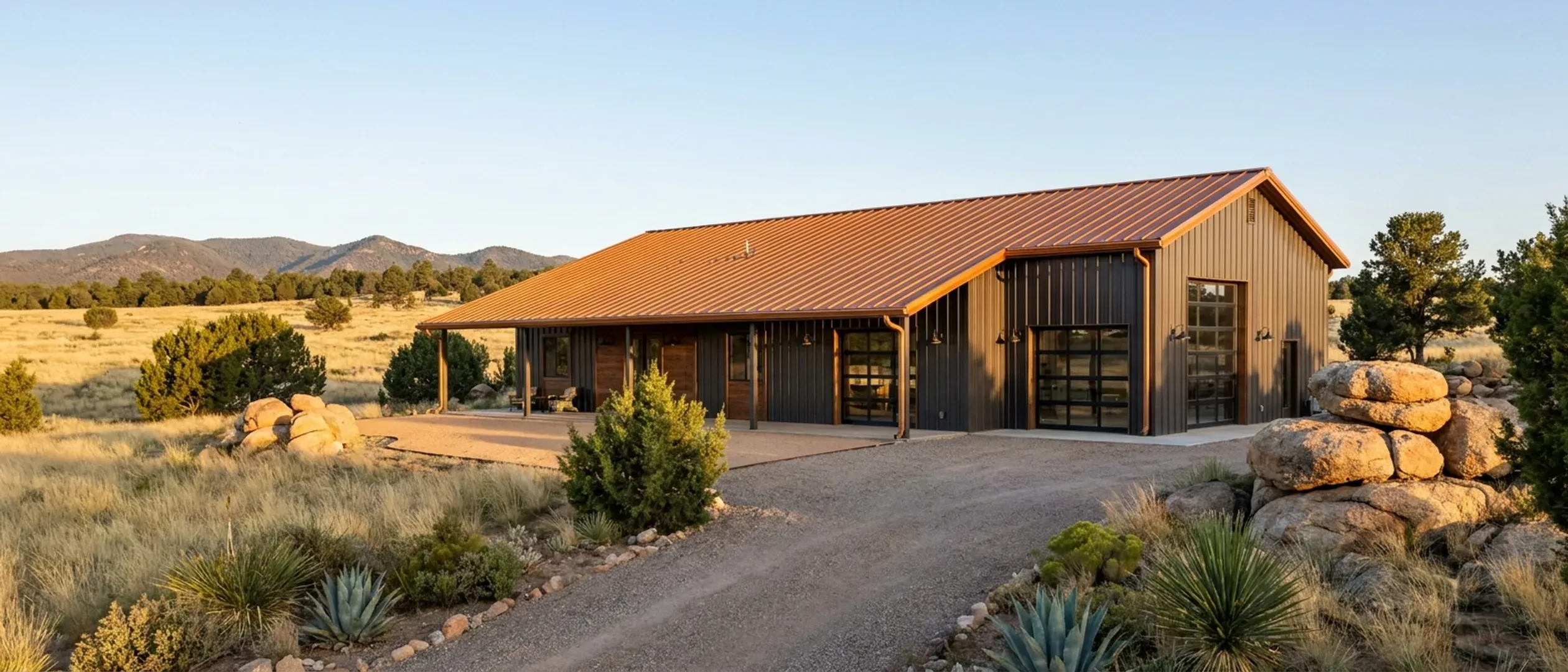
Are Barndominiums Worth It in Arizona? Land, Water, Heat, Resale and the Shop-Plus-House Case
Whether a barndominium is worth it in Arizona depends less on the building than on three other things: the land, how long you plan to stay, and whether you need the shop. A barndominium is at its strongest when it replaces two buildings, a house and a shop or RV garage, with one wide-span structure on acreage you already know can take a home, a water supply and a septic system. It is at its weakest on a lot inside a planned community whose covenants limit metal exteriors, or for a buyer who expects to sell in a few years into a market with few comparable sales. Arizona adds its own considerations. The University of Arizona's Cooperative Extension calls termites the leading urban pest in the state, which favors a steel frame. Phoenix averages its first 100-degree day on May 2 and its last on October 5, according to the National Weather Service, which puts the insulation and cooling budget at the center of long-term value. This guide weighs the case, with each Arizona point attributed to its source.
Figures on this page are cited third-party or government data, not a quote from Arizona Barndominium Builders.
Bottom Line Up Front
- Worth it: you need a real shop or RV bay, you own or are buying land outside a restrictive planned community, you have a clear answer on water and wastewater, and you plan to stay.
- Probably not: you expect to sell within a few years, you need the largest possible loan against the finished value, or the lot's CC&Rs limit metal exteriors or large shops.
- In Arizona the value is protected by the parts buyers cannot see: a steel or treated frame against termites, and insulation, air sealing and cooling designed for months of 100-degree days.
Where the answer is clearly yes
The case is strongest when several of these are true at once.
You need a real shop, and would build one anyway
RV bay, workshop, equipment storage or a home business space that zoning allows. One building does the work of two.
You own or are buying land with clear answers
Jurisdiction, zoning, water and wastewater are settled, and the lot is outside a planned community, or its CC&Rs allow the design.
You want an open, adaptable plan
Clear spans let the plan open up and change over time without moving load-bearing walls.
You intend to stay
The longer you own it, the more the shop, the durability of a steel frame and a well-insulated shell are worth, and the less a thin comparable-sales market matters.
Where the answer is probably no
None of these rule a barndominium out, but each weakens the case.
You expect to sell within a few years
Resale depends on buyers who want a barndominium, and on appraisers finding comparables. And an owner-built home sold within a year of completion is presumed to have been built for sale under A.R.S. 32-1121(A)(5).
You need the largest possible loan
A low appraisal limits the loan. If your budget depends on borrowing against the full finished value, confirm the lender's view first.
The lot is in a planned community with strict covenants
Where a subdivision is a planned community, its declaration can carry covenants on the appearance of each lot. Metal exteriors and large detached shops are common limits.
Water or wastewater is uncertain
If the parcel's water source or septic suitability is in doubt, settle it before you spend on design.
Questions that decide it for your land
Answer these for the specific parcel, and the worth-it question mostly answers itself.
Who has jurisdiction?
A city, a county or a tribal government. That decides the permits, the code and the zoning.
Does the zoning allow a home, and a building this size?
Setbacks, lot coverage, height and any limits on a shop's size or use.
Do covenants apply?
Read the CC&Rs and ask the architectural committee. Arizona law bars an association from prohibiting solar (A.R.S. 33-1816), but it can regulate a home's appearance.
Where will the water come from, and where will wastewater go?
A water provider, a well or hauled water; sewer or a septic system. Our legal guide covers the Arizona rules.
What will the lender and insurer say?
Get a lender's view on the appraisal and an insurer's quote on the actual plan before you commit.
How long will you stay?
The longer the horizon, the stronger the case.
What a barndominium does not change
Some costs and requirements are the same whatever the frame.
Site work, water and wastewater
Grading, the pad, utilities, the well or water connection and the septic system cost the same for a barndominium as for any house on the same land.
Interior finishes and mechanical systems
Kitchens, bathrooms, flooring, plumbing, electrical and cooling cost what they cost. The frame does not make them cheaper.
Permits and inspections
A barndominium used as a home is permitted and inspected as a home by the city or county that has jurisdiction, under the code it has adopted.
Reading this because you are weighing a build? The next step is a plan drawn for your program.
What's different about Arizona
The shop is where the value is
The strongest financial case for a barndominium is that it does two jobs. A family that would build a house and a separate shop, RV garage or equipment barn anyway can put both under one wide-span roof, with one foundation, one roof and one set of walls. If you would not build the shop, much of that advantage disappears and the comparison becomes a barndominium against a conventional house of the same living area. Our cost guides set out the third-party figures for that comparison.
The land decides first
In Arizona the parcel does more to decide the outcome than the building. Who has jurisdiction, what the zoning allows, whether a planned community's covenants apply, how the home gets water and how wastewater is handled are all settled before a frame is ordered. On tribal trust land the tribal government has jurisdiction, not the city or county. Our legal guide sets out how each of these works in Arizona.
Heat is a long-term cost, not only a build cost
The National Weather Service's 1991 to 2020 averages put Phoenix's first 100-degree day on May 2 and its last on October 5, and in 2024 the city recorded 143 days at 100 degrees or more. A metal-skinned building will cost what its insulation, air sealing and cooling design let it cost, every summer, for as long as you own it. Money spent on continuous insulation, a reflective roof and shade on the west and south keeps paying back; money saved there keeps costing.
Termites favor steel
The University of Arizona Cooperative Extension's guide to termite management for homeowners calls termites the leading urban pest in Arizona and names the desert subterranean termite as by far the most destructive species. A steel frame keeps the structure out of their reach, which is a durable advantage over a wood-framed house. Interior wood and paper still need the usual protection at the slab.
Appraisal is where the value question gets tested
A lender values a house from recent comparable sales. Where few barndominiums have sold nearby, the appraisal may come in below what the home cost to build, and the difference comes out of your own funds. This is the most common way a barndominium turns out to be worth less on paper than in use. Talk to a lender about the actual plan and parcel before committing.
Building it yourself is for living in, not for selling
Arizona's owner-builder exemption covers an owner who builds, alone, with employees or with licensed contractors, a home for the owner's own occupancy that is not for sale or rent. Under A.R.S. 32-1121(A)(5), selling or renting it, or offering to, within one year after completion or the certificate of occupancy is evidence it was built for sale or rent. If resale soon is part of the plan, the owner-builder route is the wrong one.
Pros and cons, honestly
Pros
- One building can replace a house and a separate shop or RV garage.
- A steel frame keeps the structure out of reach of the termites the University of Arizona calls the state's leading urban pest.
- Clear spans make the plan adaptable over decades.
- A durable metal exterior with low repainting needs.
- A metal roof suits solar panels, which Arizona associations cannot prohibit.
- The longer you stay, the more the shop and the durable shell are worth.
Cons
- Appraisals may come in low where there are few comparable sales.
- Resale depends on a narrower pool of buyers.
- Planned-community covenants can rule out the design.
- The insulation and cooling budget cannot be cut without long-term cost in desert heat.
- Site work, water, wastewater and interior finishes cost the same as for any house.
- Owner-built homes sold within a year are presumed to have been built for sale.
Are barndominiums worth it in Arizona?
Do barndominiums hold their value in Arizona?
Is a barndominium cheaper than a house in Arizona?
Is a steel barndominium worth it for termite protection?
Are barndominiums energy efficient in the Arizona heat?
Can I build a barndominium in a Valley subdivision?
Can I save money by building it myself?
What should I check before buying land for a barndominium?
Questions answered? Tell us what you want to build and we will put real numbers against it.
Sources
- University of Arizona Cooperative Extension: Termite Management for Homeowners (AZ1356)
- National Weather Service Phoenix: First and last dates for temperature thresholds
- National Weather Service Phoenix: 2024 climate year in review
- A.R.S. 32-1121: Exemptions from contractor licensing (owner-builder)
- A.R.S. 33-1802: Planned communities, definitions
- A.R.S. 33-1816: Solar energy devices; reasonable restrictions
Keep reading
The pages that answer the next question this one raises.
Barndominium pros and cons in Arizona
Heat, termites, monsoon wind, resale and HOA rules, one by one.
Read itBarndominium vs house cost
The cost comparison with every figure attributed to its source.
Read itAre barndominiums legal in Arizona?
Jurisdiction, codes, zoning, water and septic, before you buy the land.
Read itShouses
Shop-plus-house designs, where the barndominium case is strongest.
Read itTell us about your land
Start the survey and we will talk through whether the parcel and the plan fit.
Read itWant a real number instead of a range?
Start the survey and tell us about your land and what you want to build. Include the county and parcel ID if you have them, because in Arizona the city or county, the water supply, the septic permit and the impact fees change the budget more than the building does. The survey costs nothing.